Is an AI Voice Agent Too Robotic for Customer-Facing Calls?
"Will it sound robotic?"
That is one of the first objections small business owners raise about an AI voice agent—and it is a fair one.
Most people have had a bad phone experience: stiff wording, awkward pauses, a system that did not understand a simple answer, or a voice that felt like it was reading a script written for a machine.
The fear is not really about AI. The fear is that your business will sound careless on the most personal channel you have: the phone.
This post separates hype from reality. Callers do not reward "human-like" as a buzzword. They reward clarity, competence, and a clear next step. When an AI front desk delivers that, skepticism drops. When it does not, no amount of technology branding saves the call.
For scope and boundaries, read what an AI front desk actually does and does not do. For how AI compares to voicemail on missed calls, see AI receptionist vs voicemail.

What callers actually react to
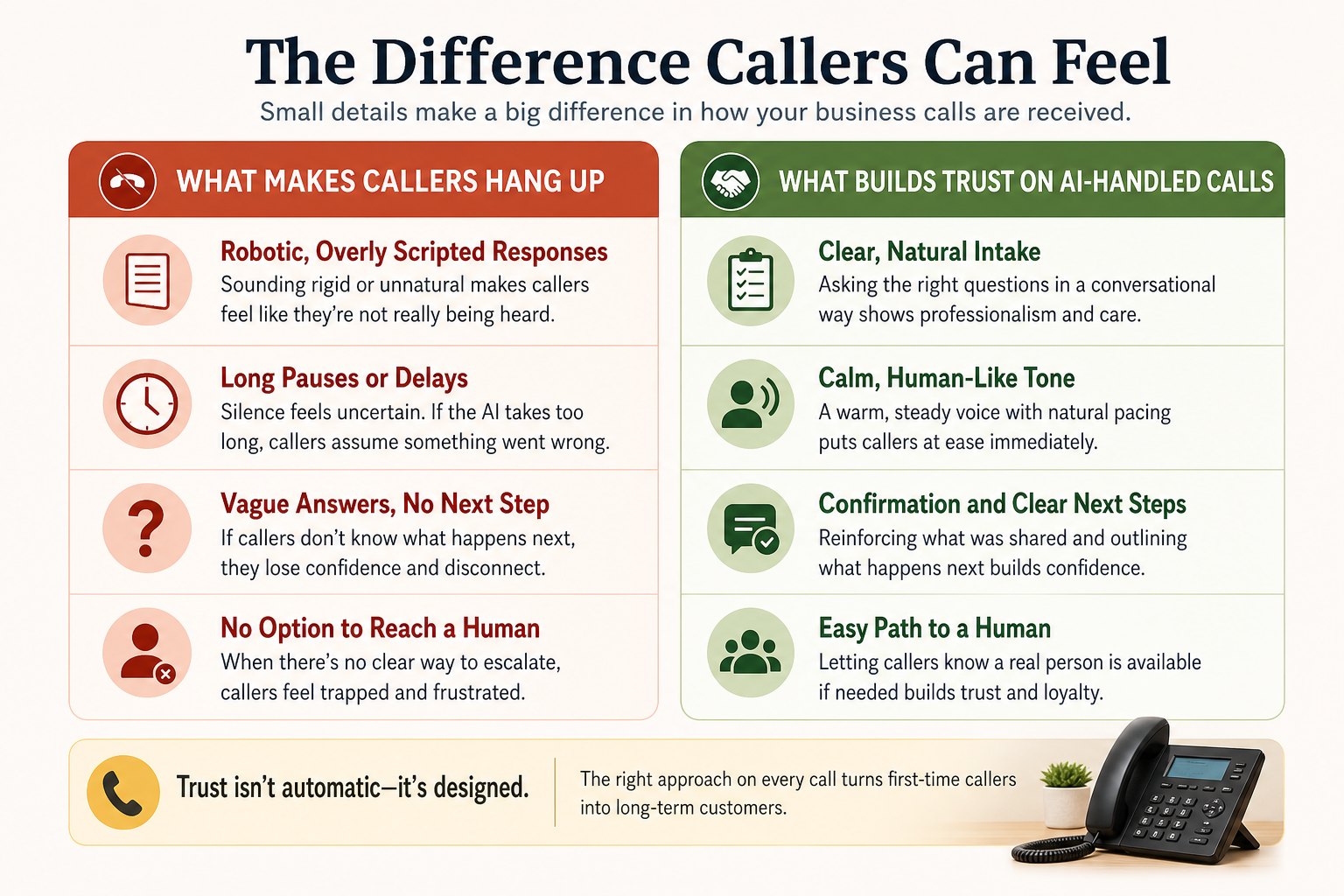
When someone says a phone experience felt "robotic," they usually mean one of these:
- the business did not understand what they needed
- the conversation looped or felt scripted in the wrong places
- there was no clear next step—just vague reassurance
- the tone felt cold or performative, not calm and professional
- they wanted a person for a sensitive issue and could not reach one
Notice what is missing from that list: most callers are not auditing whether the voice is synthetic. They are auditing whether the business sounds organized and trustworthy.
That is good news for small businesses. Trust on the phone is less about theatrical warmth and more about:
- answering promptly
- confirming they reached the right place
- asking sensible intake questions
- setting honest expectations
- handing off cleanly when a human is required
An AI front desk that does those five things consistently will outperform a tired human reading a sticky-note script—and outperform voicemail by a wide margin.
When "robotic" is a setup problem, not a technology problem
Many bad AI phone experiences are not failures of voice quality. They are failures of business design.
Script overload. If the system tries to say everything your website says, callers feel trapped in a monologue.
Wrong tone for the context. A cheerful greeting during an urgent HVAC outage lands wrong. A clinic caller with pain does not need enthusiasm—they need calm structure.
No escalation path. Callers forgive automation when they can reach a person for the thing that actually requires judgment. They do not forgive feeling stuck.
Overclaiming. When an AI voice promises what your business cannot deliver, the call feels dishonest—even if the voice sounds perfect.
Missing follow-through. A smooth call that ends with silence destroys trust faster than an imperfect voice that sends a confirmation text.
ZFire Front Desk, powered by Ziva, is built around bounded conversations: answer, capture, route, confirm—not pretend to be unlimited general intelligence.
For booking and routing expectations, see can an AI front desk book appointments and route calls.
What good customer-facing AI sounds like in practice
"Natural" does not mean mimicking small talk. It means professional phone manners your customers already recognize.
Clear identification. The caller knows who they reached and what the business can help with.
Short questions, one at a time. Real front desks do not dump ten questions at once. Good AI intake follows the same rhythm.
Plain language. No jargon, no "As an AI language model," no corporate fog.
Calm pacing. Not rushed, not artificially slow—just steady.
Honest boundaries. "I can collect details and schedule within our available windows. For pricing on complex jobs, our team will confirm after review." That is more trustworthy than a fake quote.
Confirmation. Callers should leave knowing what happens next—text, callback window, appointment hold, or escalation.
If you want to hear the experience directly, visit the homepage and talk to Ziva.
Industry nuance: where callers are more sensitive
Not every business faces the same trust bar.
Healthcare-adjacent practices (dental, chiropractic, med spa, veterinary) often have anxious callers. Tone should be calm and structured. Automation should not provide clinical advice or clearance. Your team still owns medical judgment. See examples in our dental and veterinary use cases.
Home services (plumbing, HVAC, electrical, roofing) often have urgent callers comparing multiple companies. Competence beats charm. Structured triage and fast intake win. See plumbing and HVAC scenarios.
Professional offices (legal, real estate, accounting) need credibility and clean intake. Callers may tolerate automation for scheduling but expect a human for representation, advice, or negotiation. See real estate brokerage boundaries.
The pattern: AI front desk works best on repeatable front-door conversations. Humans remain essential for judgment-heavy moments.
AI voice agent vs live receptionist: different jobs
This is not a contest about who sounds more human.
A great live receptionist brings memory, empathy, and physical presence. An AI front desk brings coverage, consistency, and relief from repetitive intake.
Many businesses use both. For the split, read AI front desk vs live receptionist: what does what.
If your receptionist is strong during core hours, AI can protect evenings, overflow, and lunch—when voicemail would have been the fallback. Callers experience that as responsiveness, not robotics.
How to evaluate whether callers will accept it
Skip abstract demos. Test against your actual call types.
Pick five real conversations your phone gets every week—for example new patient inquiry, emergency triage, estimate request, reschedule, billing question.
For each, ask:
- Can a structured script collect the right fields without annoying the caller?
- Where must a human enter—always, or only on trigger words?
- What confirmation does the caller need to trust the handoff?
- Would voicemail produce a better outcome? (Usually no for high-intent calls.)
- Would no answer cost you more than an imperfect but immediate response?
If you track how fast you call back today, compare that to live pickup with structured intake. Speed plus clarity often beats a perfect voice that arrives three hours later.
Red flags that will make your AI sound robotic no matter what
Avoid these during setup:
- pretending the AI is a named staff member who "just stepped away"
- long informational monologues before asking why the caller dialed
- refusing escalation when the caller repeats the same request twice
- collecting sensitive information your policy does not allow at the front line
- inconsistent answers to the same question across calls
- no post-call confirmation text or email when your business promises one
Those are trust killers. Fix the workflow and the experience improves—even before fine-tuning voice selection.
What ZFire Front Desk optimizes for
ZFire Front Desk is not sold as a novelty voice demo. It is an always-on front desk layer trained to your business boundaries.
That means:
- voice-forward intake that sounds professional, not performative
- scripts aligned to your services, hours, and escalation rules
- structured capture so your team gets usable context
- routing for urgency, role, and after-hours coverage
- follow-up steps so calls do not die at hang-up
Your team still owns complex judgment, pricing promises, clinical or legal advice, and anything that requires licensed discretion. The AI layer reduces the response gap when humans are unavailable—not replaces human responsibility.
For workflow detail, see how it works. For packaging, see pricing.
Take the next step
If robotic-sounding calls are your main concern, the best test is a live conversation—not a slide deck.
Talk to Ziva on the homepage and walk through your most common caller scenarios.
If you want help mapping scripts, escalation paths, and tone to your vertical, contact ZFire Media.
Learn more about ZFire Media and how we help call-heavy small businesses sound competent on every ring—not perfect, but reliably professional.