AI Front Desk vs. Live Receptionist: What Does What
Small businesses do not struggle with phone coverage because they lack options. They struggle because the options are often sold as replacements for each other, when they are actually solving different parts of the same problem.
A live receptionist and an AI front desk are not competitors. In most businesses that run well, they are layers. The human handles complexity, nuance, and the exceptions that make a business feel personal. The AI handles consistency, coverage, and the repetitive tasks that burn humans out.
This post is a direct comparison of what each does well, where each falls short, and how the businesses that get the best results think about them as complementary rather than either-or.
For a broader look at how AI front desks work in practice, see what an AI front desk actually does and does not do.
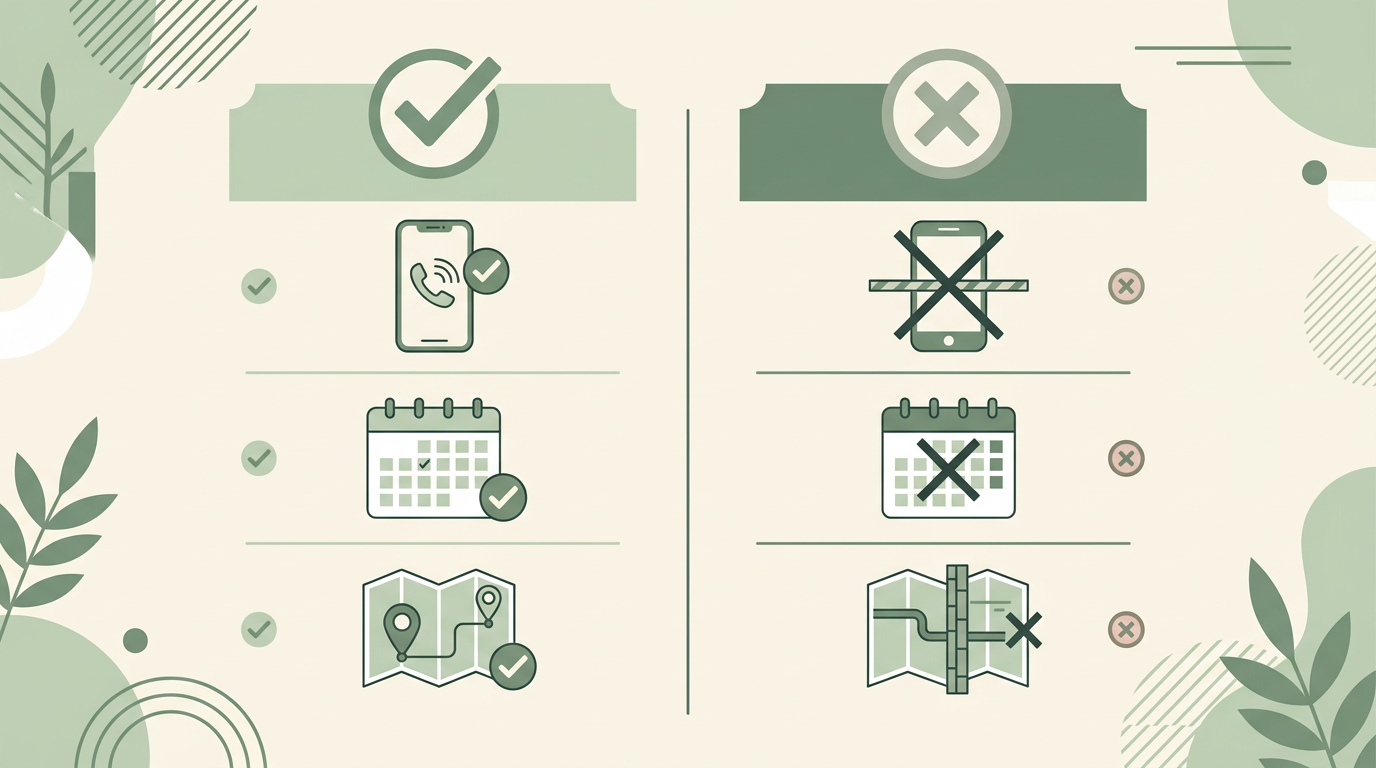
What a live receptionist is actually doing
A good live receptionist is doing far more than answering phones. They are:
Triaging calls in real time. They know which caller is already a customer versus a cold lead, which vendor is urgent versus routine, and which call needs the owner now versus can wait until after lunch. That judgment comes from memory, context, and institutional knowledge that no system captures automatically.
Handling the exception. Every business has edge cases. The customer who needs a special accommodation. The insurance adjuster who does not fit the normal script. The neighbor who walked in without calling. Humans handle exceptions because they can interpret intent, not just literal input.
Setting tone. The voice, inflection, and attentiveness of a receptionist shape how a business feels. In a dental practice, a warm front desk reduces anxiety before the patient ever sees the dentist. In a law office, a calm, professional tone signals competence. Tone is not a nice-to-have. It is part of the product.
Managing physical space. In many small businesses, the person at the front desk is also managing the waiting area, accepting packages, greeting walk-ins, and keeping an eye on things. A phone-only solution cannot do any of that.
Learning and adapting. A receptionist who has been with you for two years knows things you never trained them on. They know that Susan always needs extra time to decide. They know that Mike calls on his lunch break and wants to be efficient. They know the seasonal rhythms of your customer base.
The actual limits of a live receptionist
Live receptionists are valuable, but they are not perfect coverage.
One person can only take one call at a time. If two calls come in simultaneously, one goes to voicemail. If three come in during a storm surge, only one gets answered. Even the best receptionist has physical limits.
Humans leave. Lunch breaks, sick days, vacations, turnover. Every time a receptionist is out, coverage either collapses or falls to someone else who already has a full-time job. Temporary coverage almost never works as well as the person who knows your business.
After-hours is a gap by definition. If your receptionist works 8 AM to 5 PM, every call at 6 PM, 7 PM, or during the weekend hits voicemail. For service businesses in particular, after-hours calls are often the highest-intent leads: emergencies, urgent repairs, people who could not call during their own work hours.
Training is expensive and fragile. A new receptionist needs weeks to learn your systems, your customers, your tone. If they leave in six months, the investment resets. Turnover is a real cost that most small business owners underestimate.
Emotional fatigue is real. Receptionists absorb frustration and stress from callers. Over time, that accumulates. An AI front desk does not get tired, does not take criticism personally, and does not have bad afternoons. The value of emotional consistency is underrated.
What an AI front desk is actually doing
An AI front desk, like Ziva, is not trying to replace the judgment of a human receptionist. It is replacing the failure modes that come from relying on humans alone.
Answering every call on the first ring. Not most calls. Every call. Simultaneous calls. After-hours calls. Weekend calls. Holiday calls. The AI has no capacity limit because it is software, not a person.
Running structured intake in real time. Name, need, urgency, address, callback preference, and any other information you define are captured during the call itself—not recovered from a voicemail afterward. The structure is consistent every time, which means your team gets the same quality of information whether the call happened at 9 AM or 9 PM.
Handling common questions without human interruption. Hours, service areas, pricing ranges, what to expect during a visit, how to prepare for an estimate—these are questions that eat up receptionist time and that callers can get answered instantly. The human team only gets pulled in when the question genuinely exceeds what the system is trained on.
Routing with full context. When a call does need a human, the AI forwards it with the intake already captured. The human does not answer a blank line and ask the caller to repeat everything. They answer with information already in front of them.
Sending confirmation and follow-up texts automatically. The post-call workflow runs without anyone having to remember. The caller gets a text they can act on. The team calendar gets the block. The follow-up gets scheduled. None of this depends on a human remembering to do it.
Staying available during failure windows. Lunch, commute, overflow, overflow again. The AI does not have a lunch break. It does not get overwhelmed. It does not need to put someone on hold while it finishes a different task.
The limits of an AI front desk
AI front desks are powerful, but they have boundaries.
Complex exceptions are not handled automatically. If a caller has a situation that genuinely requires human judgment—an insurance dispute, a special accommodation, a nuanced complaint—the AI should route to a human with full context. It is not a replacement for judgment. It is a filter that ensures humans only spend time on things that need judgment.
Physical presence is impossible. An AI cannot greet a walk-in, accept a delivery, tidy the waiting area, or manage a lobby. If your business depends on physical front-desk presence, an AI front desk is a phone layer, not a replacement for the person at the desk.
Context that exists only in memory requires training. A human receptionist who knows your regular customers can greet them by name, ask about their family, and remember that they hate morning appointments. An AI can be trained on known preferences, but it cannot replicate the organic, ever-changing memory of a human who has been with your business for years.
Tone is controllable but not spontaneous. Modern AI voices are excellent and natural, but they are designed, not spontaneous. If your business depends on a receptionist who improvises, jokes, or reads the room in ways that are hard to script, the AI will feel different—not necessarily worse, but different.
Where the most successful businesses put each piece
The businesses that get the best results from phone coverage do not treat it as a binary choice. They map the actual call patterns and match the tool to the job.
Scenario 1: Full-time receptionist, AI as overflow and after-hours
A dental practice with one full-time front-desk person uses a human during business hours and an AI front desk for everything else. The human handles complex scheduling, insurance questions, and anxious patients. The AI handles night and weekend calls, captures new patient inquiries after hours, and prevents the practice from losing leads to voicemail.
Result: The receptionist is protected from after-hours interruption. The practice captures 30–40% more leads that would have gone to voicemail.
Scenario 2: No receptionist, AI as primary coverage
A solo electrical contractor who runs his own business has no desk staff at all. He uses an AI front desk as his primary phone system. It answers every call, collects intake, and forwards only the jobs he wants to take. He checks his messages between jobs instead of fielding calls while under a panel.
Result: He captures all leads without carrying two phones or interrupting work. The AI filters out the calls he does not want (spam, low-value requests) so his limited time goes to real opportunities.
For how this works in practice, see our electrical contractor use case.
Scenario 3: Receptionist part-time, AI covering the gaps
A chiropractic office has a receptionist 8 AM to 1 PM, but afternoons are handled by the chiropractor directly. The AI covers 1 PM to 8 PM, handles overflow during the lunch rush, and captures calls on weekends when the office is closed entirely.
Result: The part-time receptionist does not feel understaffed because the AI handles the volume spikes. The chiropractor gets to focus on patients instead of listening to voicemails between adjustments.
For the chiropractic angle, see our chiropractic practice use case.
Scenario 4: AI handling intake, humans handling delivery
A roofing company uses an AI front desk to handle every first call. The AI captures address, insurance status, damage description, and urgency. If the caller seems high-value (insurance claim, storm damage, residential replacement), the AI routes to the estimator immediately. Lower-priority calls get scheduled for callback windows.
Result: The estimators only spend phone time on qualified leads. The AI never misses a storm surge call, even when forty calls come in after a hail event.
See our roofing company use case for the full breakdown.
The five questions to ask before choosing your setup
If you are evaluating how to structure your phone coverage, start with these questions in order.
1. When do most of your calls come in? If your peak call windows are during business hours when someone is at the desk, a human receptionist may be your primary layer. If your peak is after hours, weekends, or during specific seasonal surges, an AI front desk is likely more important than a daytime human.
2. What percentage of your calls are routine versus complex? If 80% of calls are "hours, pricing, appointment scheduling, status checks," an AI can handle most of that without human involvement. If 80% of calls are complex negotiations, exceptions, or complaints, you need a human as the primary layer.
3. What happens when two calls come in at once? If your answer is "voicemail," you have a coverage gap regardless of how good your single receptionist is. Every business that relies on one person at one desk has a simultaneous-call problem. An AI front desk fixes this instantly.
4. What is your actual cost of a missed lead? If a single missed call costs you $500–$1,500 in revenue, and you miss ten calls a week, the math of AI coverage becomes obvious. If a missed call costs you $30 in potential revenue, the urgency is lower. Most service businesses underestimate this number because they do not track conversion from first call.
5. What does your team actually want to do? Your office manager may hate answering phones but love managing the schedule. Your field tech may hate taking customer calls but is great at complex repairs. The best phone system is the one that lets humans do the work they are good at and handles the rest automatically.
The honest bottom line
A live receptionist and an AI front desk are not enemies. They are different tools for different parts of a single workflow.
The live receptionist brings judgment, warmth, institutional memory, and physical presence. The AI front desk brings coverage, consistency, speed, and scale. The businesses that treat them as competitors tend to underuse both. The businesses that treat them as layers tend to convert more leads, retain more staff, and grow more steadily.
If you have a good receptionist, an AI front desk protects their time and extends their reach to the hours they cannot cover. If you have no receptionist, an AI front desk gives you the coverage layer that most businesses lack entirely.
The question is not "human or AI?" The question is "where does each fit in my actual call flow?"
If you want to see how an AI front desk would handle your specific call patterns, talk to Ziva live on our homepage. She can walk through your business and show you exactly what coverage looks like.
For a tailored demo that matches your vertical and call volume, contact ZFire Media.
Learn more about ZFire Media and how we design phone systems for call-heavy small businesses that grow.