AI Receptionist vs Voicemail: What's the Real Difference?
When a small business owner asks whether they need an AI receptionist, the real question is often simpler: what happens when nobody can pick up the phone?
For most call-heavy businesses, the default answer is voicemail. It is familiar, cheap, and already installed. An AI front desk sounds like a bigger decision—new technology, new setup, new expectations.
But the comparison is not "fancy AI versus a normal business phone." It is live response with structured intake versus a recording that asks the caller to hope someone calls back.
This post compares those two paths honestly: what callers experience, what your team gets on the other end, and where each option breaks down.
For the revenue side of missed rings, start with why small businesses lose revenue when calls go unanswered. For callback timing once a call is missed, see how fast small businesses should call back.
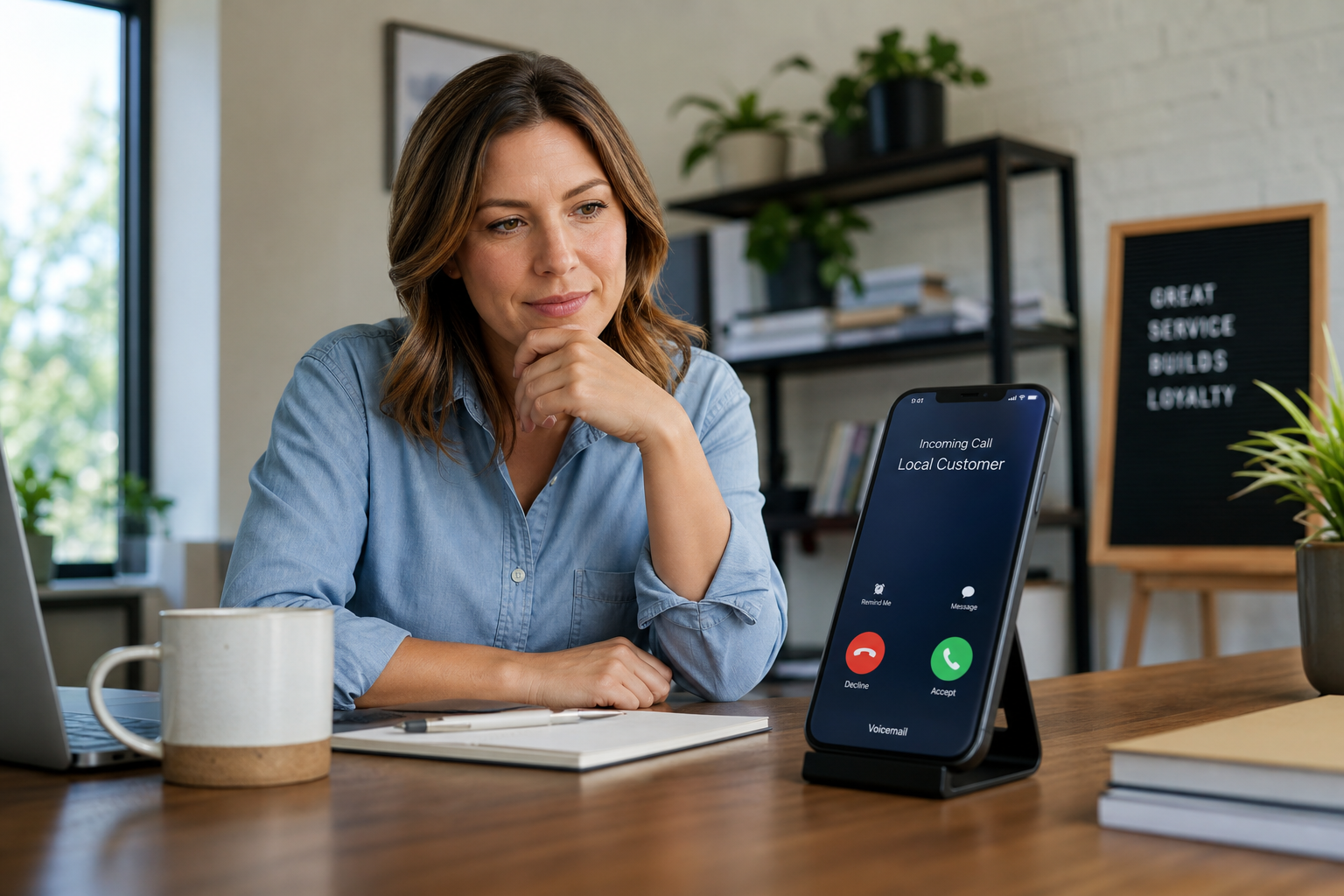
What voicemail actually gives you
Voicemail is not useless. It is a message capture tool with a specific job: record audio when a live person is unavailable.
When it works, a motivated caller leaves a name, number, and clear request. Your team listens later, calls back, and picks up the conversation. For low-urgency inquiries or existing customers who already trust you, that can be enough.
But voicemail has structural limits that show up on almost every small business phone:
Many callers never leave a message. They wanted a person, not a recording. The beep is often where the relationship ends.
Messages are inconsistent. One caller gives full detail. The next says "call me back." Your team still has to chase context.
Timing is passive. Voicemail stores the request. It does not answer questions, set expectations, or keep the caller moving toward a next step.
Simultaneous calls still fail. Voicemail handles overflow the same way a busy signal does—one caller at a time, everyone else waits or hangs up.
After-hours feels like a closed door. A generic "leave a message" at 7 PM does not reassure someone with an urgent leak, a broken AC unit, or a painful dental issue.
Voicemail is a storage bin for intent. It is not a front desk.
What an AI front desk does on the same call
An AI front desk—like Ziva, the voice layer behind ZFire Front Desk—is built for a different job: answer the call live, capture structured information, and move the caller toward a clear next step.
That does not mean pretending to be a human who can handle every edge case. It means removing the worst failure mode in the comparison: the caller who needed help now and got a recording instead.
On a typical inbound call, an AI front desk can:
- Answer on the first ring, including after hours, weekends, and overflow when your desk is already on another line
- Handle common questions within boundaries you define—hours, service area, what to expect, how scheduling works
- Run structured intake so every call produces the same core fields: who called, what they need, urgency, and how to reach them
- Route or escalate when the situation exceeds what automation should handle, with context already captured
- Trigger follow-up steps such as confirmation texts or callback tasks so the post-call workflow does not depend on memory
For a plain-English definition of scope and limits, read what an AI front desk actually does and does not do.
The difference is not that voicemail is "old" and AI is "new." The difference is passive capture versus active coverage.
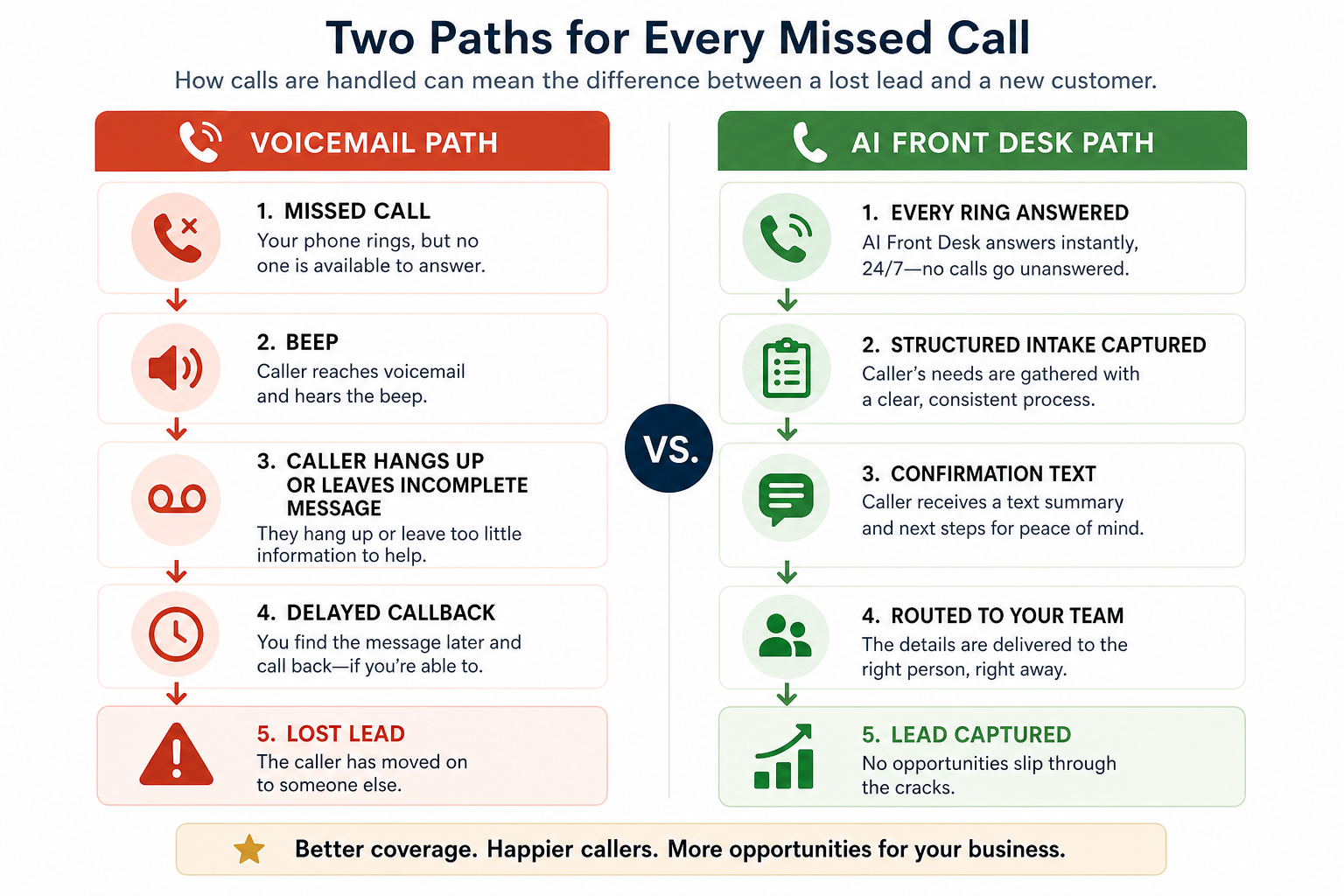
Side by side: the same caller, two paths
Imagine a homeowner with a water stain spreading on the ceiling. They call three plumbers between lunch and 1 PM.
Path A: Voicemail
- Call one rings four times and goes to voicemail. They listen to a greeting, wait for the beep, and start talking while still anxious.
- They are not sure what details matter. They leave a name and say there is a leak.
- They call the next company.
- Your office manager returns the message at 2:30 PM. The caller already booked someone who answered live at 12:47.
Voicemail did its job technically. It recorded audio. It did not protect the lead.
Path B: AI front desk
- Call one is answered immediately. The caller hears a calm, professional voice that confirms they reached the right business.
- The system collects address, whether water is still active, photos-or-access questions your team scripted, and a preferred callback or booking window.
- The caller gets a text summarizing what was captured and what happens next.
- Even if they still call two other companies, you entered the comparison with competence and clarity, not silence.
Same marketing spend. Same market. Different front line.
Where the gap shows up most
Voicemail and an AI front desk feel similar only when call volume is low and urgency is low. The gap widens in predictable situations.
After-hours and weekends. Important calls do not respect business hours. For a deeper look at nights and weekends, see after-hours call handling for small business.
Peak-season surges. When summer heat, storm damage, or Monday-morning backlog hits, voicemail becomes a pile—not a system. See why summer call volume breaks small business phone systems.
Comparison shopping. Callers working down a list reward the first business that sounds organized. Voicemail rarely wins that contest.
Simultaneous calls. One person at the desk plus voicemail still means one live conversation and everyone else waiting.
Incomplete messages. "Call me back" is not intake. Your team still starts cold.
This is why the comparison matters more for service businesses, clinics, and professional offices than for businesses where phone calls are rare and low-stakes.
When voicemail is still reasonable
An AI front desk is not mandatory for every business. Voicemail can be fine when:
- Calls are infrequent and mostly from people who already know you
- Urgency is low and next-day response is normal in your market
- You have reliable staff who return messages quickly and consistently
- The cost of a missed call is low relative to the cost of coverage
Even then, voicemail works best when it is disciplined: short greeting, clear promise, fast callback, and someone actually listening.
The problem is not that voicemail exists. The problem is treating voicemail as phone coverage when your business actually needs responsive intake.
How this relates to live staff
Voicemail versus an AI front desk is not the same question as human versus automation.
Most strong setups use layers. A live receptionist—or owner, or office manager—handles complexity when available. An AI front desk covers overflow, lunch, after-hours, and the calls that would otherwise hit a recording.
For that split, read AI front desk vs live receptionist: what does what.
Think of voicemail as what happens when every layer above it failed. An AI front desk is one way to reduce how often you end up there.
What to measure before you change anything
If you are deciding whether voicemail is costing you more than a coverage layer would, track a short sample honestly:
- How many inbound calls go to voicemail in a typical week?
- How many messages are incomplete or never returned?
- How long between missed call and meaningful follow-up?
- How many booked jobs or appointments trace back to first-call pickup?
You do not need perfect CRM data. A notepad and two weeks of honest logging usually reveal the pattern.
If missed calls cluster in specific windows—lunch, after 5 PM, storm days—that tells you where coverage matters, not just whether you need it.
How ZFire Front Desk fits
ZFire Front Desk is designed for businesses that have outgrown "leave a message" as their primary overflow plan.
Ziva answers live, stays within guardrails you set, captures intake consistently, and supports routing toward booking, callback, or human escalation depending on your workflow. The goal is not to eliminate your team. The goal is to stop losing callers in the gap between intent and response.
For setup and workflow detail, see how it works. For packaging, see pricing.
Take the next step
If voicemail is your default overflow plan and you suspect it is leaking leads, it is worth hearing what live coverage sounds like for your call types.
Visit the homepage and talk to Ziva—she can walk through a sample caller scenario in your language.
If you want a tailored review of your call patterns and failure windows, contact ZFire Media.
Learn more about ZFire Media and how we help call-heavy small businesses close the response gap without adding payroll stress.