What Customers Expect When They Call a Business in 2026
When someone calls your business, they are not grading you on a curve.
They are comparing you to the last three companies they tried today—the one that answered on the first ring, confirmed they reached the right place, asked sensible questions, and told them what happens next.
That is the baseline in 2026. Not because customers became impatient overnight, but because responsiveness is visible everywhere else in their lives: text confirmations, same-day delivery updates, online booking with instant confirmation, and chat replies that arrive in minutes.
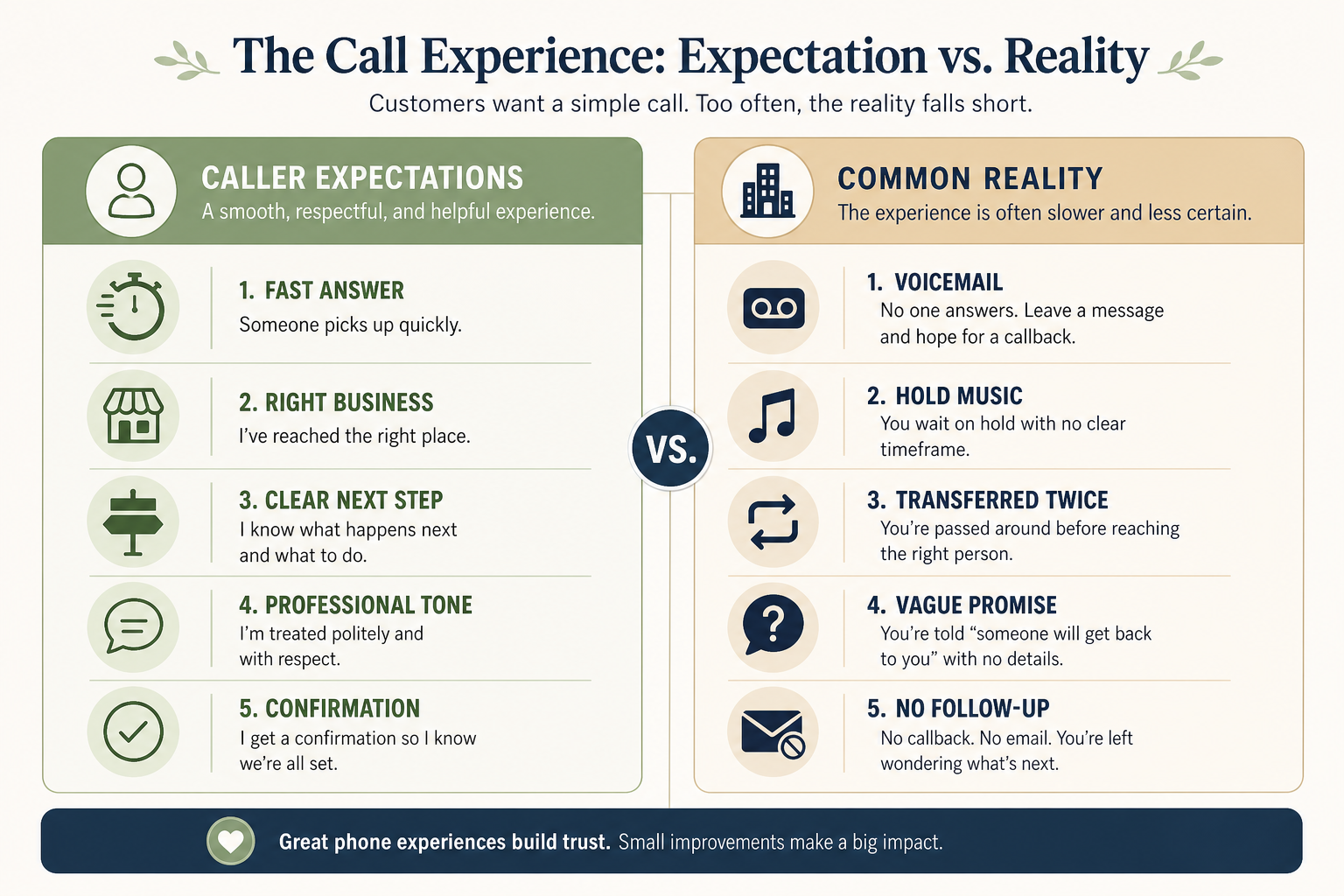
Small business owners often hear "people expect too much." Sometimes that is true. More often, the gap is simpler: callers expect competence, clarity, and a next step—and many phone systems still deliver hold music, voicemail, and vague promises instead.
This post covers what customers actually expect when they call a service business in 2026, where owners misread those expectations, and how to close the gap without building a corporate call center.
For the revenue side of missed rings, see why small businesses lose revenue when calls go unanswered. For after-hours gaps specifically, read after-hours call handling for small business.

The five expectations behind almost every business call
Most inbound calls compress into a short list of needs. Callers rarely articulate all five—but they feel it when any one is missing.
1. Someone answers—or the business feels closed
This is not "a human within three rings at all costs." It is evidence that the business is operational.
Voicemail can signal closure, especially after hours or during busy windows. Callers working down a list interpret silence as "try the next company."
Expectation: a live response or a clear, immediate alternative (structured intake, callback promise with timeline—not a generic beep).
2. They reached the right business
Misdials happen. So do Google Maps errors and shared office lines. Callers want early confirmation: business name, service type, location if relevant.
Expectation: a professional greeting that orients them in the first ten seconds.
3. The business understands why they called
Callers do not want to repeat their story three times. They expect whoever answers—human or system—to capture the reason for the call in plain language: new appointment, emergency, billing question, existing job status.
Expectation: structured intake, not open-ended "how can I help you?" loops that go nowhere.
4. They know what happens next
Ambiguity kills trust faster than a less-than-perfect voice. Callers want a next step they can repeat to themselves: "They will call me back before 3," "I am booked for Thursday at 10," "A technician will text when they are en route."
Expectation: explicit commitment—who does what, and by when.
5. Follow-through matches the promise
The call is not over at hang-up. If you said someone would text, someone should text. If you promised a callback window, missing it feels worse than never answering at all.
Expectation: confirmation and continuity—see the 3 things every business should do after a customer call.
What changed—not the customer, the comparison set
Owners sometimes frame this as "people got spoiled." A more useful frame: comparison shopping is default.
A homeowner with a leak calls four plumbers. A patient with tooth pain calls three offices. A buyer curious about a listing calls until someone sounds ready.
In 2026, that list often includes:
- national brands with 24/7 answering services
- local competitors who added overflow coverage
- businesses that use inbound call handling layers for nights and lunch
- companies that send Missed-Call Text Back when live pickup fails
Your caller is not comparing you to your staffing plan from 2019. They are comparing you to whoever answered best in the last hour.
That does not mean you must match enterprise budgets. It means the first conversation must sound organized—because disorganized is the signal that sends them to the next name on the list.
Where small businesses commonly fall short
These failure modes show up across trades, clinics, and professional offices. They are rarely about bad intentions.
Voicemail as default overflow. Callers who wanted live help often never leave a message. See AI receptionist vs voicemail.
The multitasking answer. Staff help an in-person customer while half-listening on the phone. Both conversations suffer. See why front desk interruptions cost more than most owners realize.
Hold without context. "Please hold" with no estimate, no option, and no return greeting erodes trust quickly.
Transfer loops. "Let me transfer you" twice before the caller reaches someone who can help.
Overpromising on the phone. "We can definitely be there today" when dispatch has not seen the schedule.
Slow callback after a miss. Speed matters once intent is lost. See how fast small businesses should call back.
After-hours dead ends. Important calls arrive when the desk is closed. A generic mailbox does not meet the "business is operational" test.
None of these require a villain. They are what happens when one channel is asked to carry infinite demand without coverage rules.
Expectations by call type (and why one script fails)
Not every caller wants the same experience. Treating all calls identically is how businesses sound robotic—not because of AI, but because of wrong tone for the context.
| Call type | What callers expect | What breaks trust |
|---|---|---|
| Emergency / urgent | Calm triage, safety language, clear escalation | Cheerful scripts, long menus, "call back tomorrow" |
| New lead / quote | Fast intake, service area check, booking or callback path | Voicemail, vague "we will get back to you" |
| Existing customer | Recognition, job or appointment context | Starting from zero every time |
| Scheduling | Real availability or honest scheduling process | Fake "any time works" without calendar discipline |
| Billing / admin | Direct path or committed callback window | Endless holds with no resolution |
Strong phone experiences route by intent early—even if routing means "capture details and promise a specialist callback in two hours."
For booking and routing boundaries, see can an AI front desk book appointments and route calls.
What callers do not actually require
Clearing up myths saves money and reduces fear of change.
They do not require your owner every time. They require someone competent on the first mile.
They do not require infinite small talk. Warmth matters; rambling does not.
They do not require pretending AI is human. They require honest, bounded help—see is an AI voice agent too robotic for customer-facing calls.
They do not require 24/7 human staffing. They require responsive coverage in the windows when your market actually calls—which often includes evenings and weekends even if you are not open for walk-ins.
They do not require perfection. They require recovery: if something goes wrong, acknowledge it and fix the next step.
How to meet 2026 expectations without a call center
You do not need forty seats and a script factory. You need architecture:
Define failure windows. Lunch, Monday 9–11 AM, storm days, after 5 PM—where do calls fail today?
Separate first-line from judgment calls. Repetitive intake can be consistent; pricing nuance and upset customers may still need humans.
Use structured lead qualification. Same core fields every time so partial attention still produces usable records.
Set escalation rules. Callers forgive automation when they can reach a person for the thing that requires judgment.
Add overflow and after-hours coverage. Humans for walk-ins; a coverage layer for rings when the desk is occupied or closed.
Discipline after hang-up. Confirmation, calendar blocking, follow-up scheduling—see post-call workflow.
Measure both misses and messy answers. Answered calls that produce incomplete intake still fail the comparison test.
This is where ZFire Front Desk, powered by Ziva, fits: live answer, bounded FAQs, structured intake, routing, and escalation in the windows you define—so your team can stay present for in-person work without leaving callers in voicemail.
For scope and limits, read what an AI front desk actually does and does not do. For setup detail, see how it works.
Honest boundaries
No phone system eliminates every hard conversation. Clinical triage, complex disputes, custom estimates, and emotionally charged situations may still require your best people.
The goal is not to automate trust. The goal is to stop losing ordinary calls—scheduling, FAQs, service area checks, standard intake—because the desk was underwater or closed.
If your business wins on deep relationships, protect that lane. Use coverage tools for the repetitive first mile.
What to audit this week
You do not need a consultant to learn something useful. Run five test calls—or review five recent recordings if you have them:
- How long until a live response or clear alternative?
- Does the greeting confirm the right business?
- Is intake complete enough that a callback would start warm?
- Is the next step explicit?
- Did follow-through match what was promised?
If the honest answers are weak in predictable windows, the fix is usually coverage design, not "try harder."
Take the next step
If you suspect your phone experience is costing comparison shoppers—but you are not ready to hire a full-time receptionist—it is worth hearing what structured first-line coverage sounds like for your call types.
Visit the homepage and talk to Ziva—walk through your most common caller scenarios in plain language.
For packaging, see pricing. For industry-specific workflows, see solutions by industry. If you want help mapping failure windows to coverage options, contact ZFire Media.
Learn more about ZFire Media and how we help call-heavy small businesses meet caller expectations without corporate overhead.