Why Front Desk Interruptions Cost More Than Most Owners Realize
The phone rings while someone is mid-sentence at the front desk.
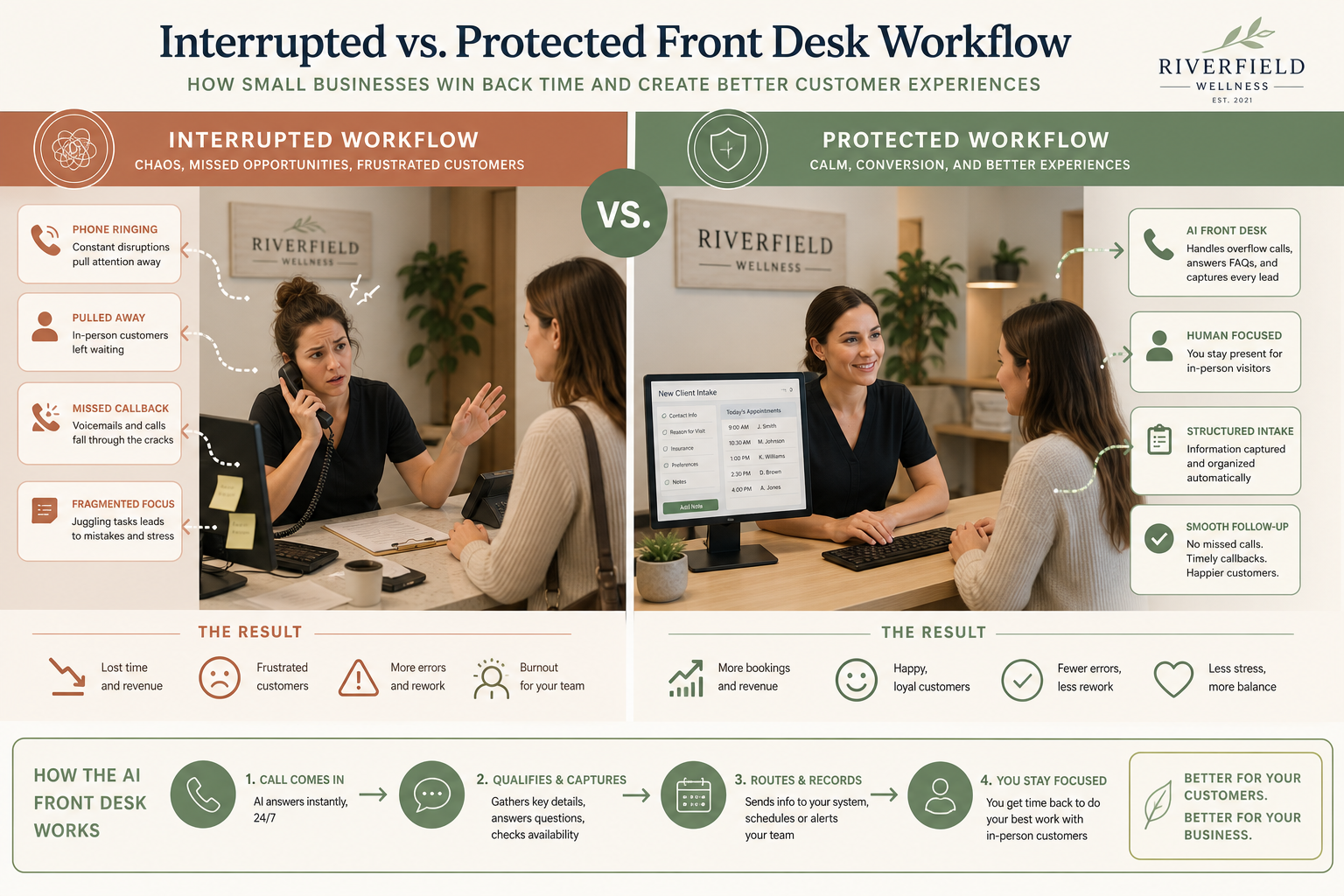
Your office manager picks up, apologizes to the person standing there, and starts intake on a new caller. Two minutes later the in-person customer is still waiting. The caller on the phone gets half-attention. A third line starts ringing before either conversation is finished.
Most small business owners treat this as normal. It is the cost of being busy.
But "busy" is not the same as "efficient." Front desk interruptions are one of the quietest ways service businesses leak revenue—not because the phone is bad, but because one person is being asked to do two jobs at once, and both jobs suffer.
This post explains why those interruptions cost more than most owners realize, what actually breaks when the desk is always reactive, and how coverage layers—including an AI front desk—reduce the damage without pretending humans are interchangeable.
For the revenue side of missed rings, see why small businesses lose revenue when calls go unanswered. For how AI and live staff split work, read AI front desk vs live receptionist: what does what.

The hidden math: one interruption is never just one interruption
When owners estimate the cost of phone problems, they usually count missed calls or voicemail left unreturned. That is real, but it is incomplete.
A front desk interruption also costs:
Attention on the person in front of you. In-person customers notice when staff break eye contact to grab the phone. Even a polite "one moment" signals that the ringing line outranks them. In service businesses where trust is built face-to-face—clinics, showrooms, consult rooms—that friction shows up in reviews and repeat business.
Completion time on work already in progress. Scheduling, checkout, insurance verification, estimate walkthroughs, and payment conversations all have a restart cost. Research on task switching is clear: when people bounce between tasks, both take longer and error rates rise. Your front desk is not exempt because the work looks simple.
Quality of intake on the phone. A distracted answer sounds rushed. Callers get vague questions, incomplete notes, and callbacks that start cold. The call was "handled," but not well.
Ripple effects on the rest of the team. The tech who needed a gate code. The provider waiting on a rooming decision. The estimator whose calendar block got blown up because scheduling was interrupted mid-booking.
Owners often see one interrupted hour. The business pays for three or four downstream delays that never show up on a phone report.
What front desk interruptions actually look like day to day
Interruptions are not always dramatic. They are repetitive.
The double conversation. Staff talk to a caller while nodding at someone at the counter—doing neither conversation fully.
The hold-and-hope pattern. Caller placed on hold while staff help an in-person visitor. Hold stretches. Caller hangs up. No one logs it as a lost lead.
The lunch-hour cliff. One person at the desk eats at their keyboard because stepping away means phones go unanswered. That is not a staffing win. It is a coverage gap wearing a badge of dedication.
The owner-as-receptionist trap. In many small businesses, the most expensive person in the building also answers overflow calls because "nobody else can decide." Every ring pulls them out of estimates, hiring, vendor negotiations, or field supervision.
The sticky-note handoff. Caller details scribbled while multitasking, passed to someone else who was not on the call. Context disappears. Follow-up slows.
None of this means your team is failing. It means the front desk job description quietly expanded to include "always available by phone" without adding capacity, tools, or boundaries.
Why owners underestimate the cost
Three beliefs keep the pattern in place.
"We are supposed to be reachable." Yes—but reachable is not the same as one human answering every ring live no matter what else is happening. Customers want responsiveness. They do not require your best estimator to stop mid-quote because line two lit up.
"Missed calls are the only phone metric that matters." Answered calls can still fail. A call answered poorly produces rework, callbacks, and lost comparison shoppers who wanted competence, not just a pickup.
"Hiring fixes it." Sometimes. But a second admin is expensive, hard to train, and still goes home at 5 PM. Interruptions also spike in predictable windows—Monday mornings, post-storm surges, seasonal peaks—not evenly across the week. Payroll does not flex that way.
The underestimation is emotional as much as financial. Interruptions feel like diligence. They look like service. Under the surface, they are structural overload on a role that was never designed to be infinitely interruptible.
Where the money actually goes
You do not need invented statistics to see the pattern. Track honestly for two weeks:
| Signal | What it usually means |
|---|---|
| In-person waits spike when phones are busy | Front desk is the bottleneck for two channels |
| Callbacks start without full context | Intake happened while distracted |
| Same questions answered repeatedly by different staff | No consistent first-line coverage |
| After-hours calls go to voicemail | Coverage ends when the desk closes |
| Owner time consumed by "quick calls" | Highest-cost labor doing first-line intake |
Add one more question owners rarely ask: how many jobs or appointments were lost not because nobody answered, but because the first conversation felt disorganized?
Comparison shoppers rarely say "your hold music was bad." They simply book the next company that sounded ready.
For after-hours gaps specifically, see after-hours call handling for small business. For peak-season overload, see why summer call volume breaks small business phone systems.
What usually fails when owners try to patch it
Common fixes treat symptoms, not the interrupt-driven design.
Voicemail as overflow. Better than silence, but passive. Callers who wanted live help often never leave a message. See AI receptionist vs voicemail for an honest comparison.
"Just call them back faster." Speed helps after a miss. It does not fix half-attention during the answer. See how fast small businesses should call back.
Ring-all phones to mobile. Now everyone is interrupted, not just the desk. Urgency spreads instead of being contained.
More signage asking people to wait. Politeness is not capacity.
Blaming staff for bad notes. Notes reflect the conditions under which they were taken.
The fix is not "care more." It is separating first-line phone coverage from the work that requires uninterrupted focus.
A more realistic front desk model
Strong small businesses treat the front desk as two channels with different rules:
In-person channel: human judgment, warmth, problem-solving, exceptions.
Phone channel: immediate answer, consistent intake, clear next step, escalation when needed.
Those channels collide when one person is solely responsible for both at all times.
Practical layers that reduce interruption without killing responsiveness:
Defined overflow rules. When the desk is with a customer, overflow goes somewhere reliable—not to a mental note to "check voicemail later."
Structured intake scripts. Same core fields every time so partial attention still produces usable records.
After-hours and lunch coverage. Predictable failure windows get predictable coverage.
Human escalation paths. Automation or first-line coverage handles repetition; people handle judgment.
Post-call discipline. What happens after hang-up matters as much as the greeting. See the 3 things every business should do after a customer call.
This is where an AI front desk fits—not as a replacement for your team, but as a buffer that absorbs rings when humans are already doing human work.
ZFire Front Desk, powered by Ziva, answers live, captures structured details, handles bounded FAQs, and routes or escalates based on rules you set. Your staff stay present for the person in front of them while callers still get a professional first response.
For scope and limits, read what an AI front desk actually does and does not do. For setup detail, see how it works.
Honest boundaries
No coverage layer eliminates every interruption. Emergencies, angry callers, unusual clinical questions, and custom pricing conversations may still need a person.
The goal is not zero rings at the desk. The goal is to stop treating every ring as an emergency that overrides everything else already making you money.
If your business runs on relationships and complex judgment, keep humans in that lane. Use coverage tools for the repetitive first mile: answer, qualify, capture, confirm, route.
What to do this week
You do not need a full phone overhaul to learn something useful.
- Log one week of desk interruptions. Who was helping whom when the phone rang? What got delayed?
- Separate missed calls from messy answers. Both matter; they imply different fixes.
- Identify your failure windows. Lunch, end of day, and seasonal peaks are common.
- Decide what must stay human-only. Everything else is a candidate for first-line coverage.
If the log shows constant task switching and incomplete intake, the problem is not effort. It is architecture.
Take the next step
If your front desk feels permanently behind—and you suspect interruptions are costing more than missed-call reports show—it is worth hearing what structured first-line coverage sounds like for your call types.
Visit the homepage and talk to Ziva—walk through a sample caller scenario in plain language.
For packaging and setup options, see pricing. If you want a tailored review of your call patterns and failure windows, contact ZFire Media.
Learn more about ZFire Media and how we help call-heavy small businesses protect focus without sacrificing responsiveness.