AI Front Desk vs Hiring Another Admin: What Small Businesses Should Consider
"We probably just need to hire someone."
That is one of the first answers small business owners give when calls pile up, voicemail overflows, and the front desk feels permanently behind.
Sometimes hiring is the right move. But "another admin" is not a single decision—it is payroll, training, scheduling, turnover, and coverage windows that still end at 5 PM unless you staff for nights and weekends too.
An AI front desk is not a replacement for every human role. It is a coverage layer for predictable first-line work: answer, qualify, capture, route, confirm. The honest question is not "human or machine." It is what problem you are solving and what each option actually costs in money, time, and operational risk.
For how AI and live staff split work, see AI front desk vs live receptionist: what does what. For interruption costs at the desk, read why front desk interruptions cost more than most owners realize.
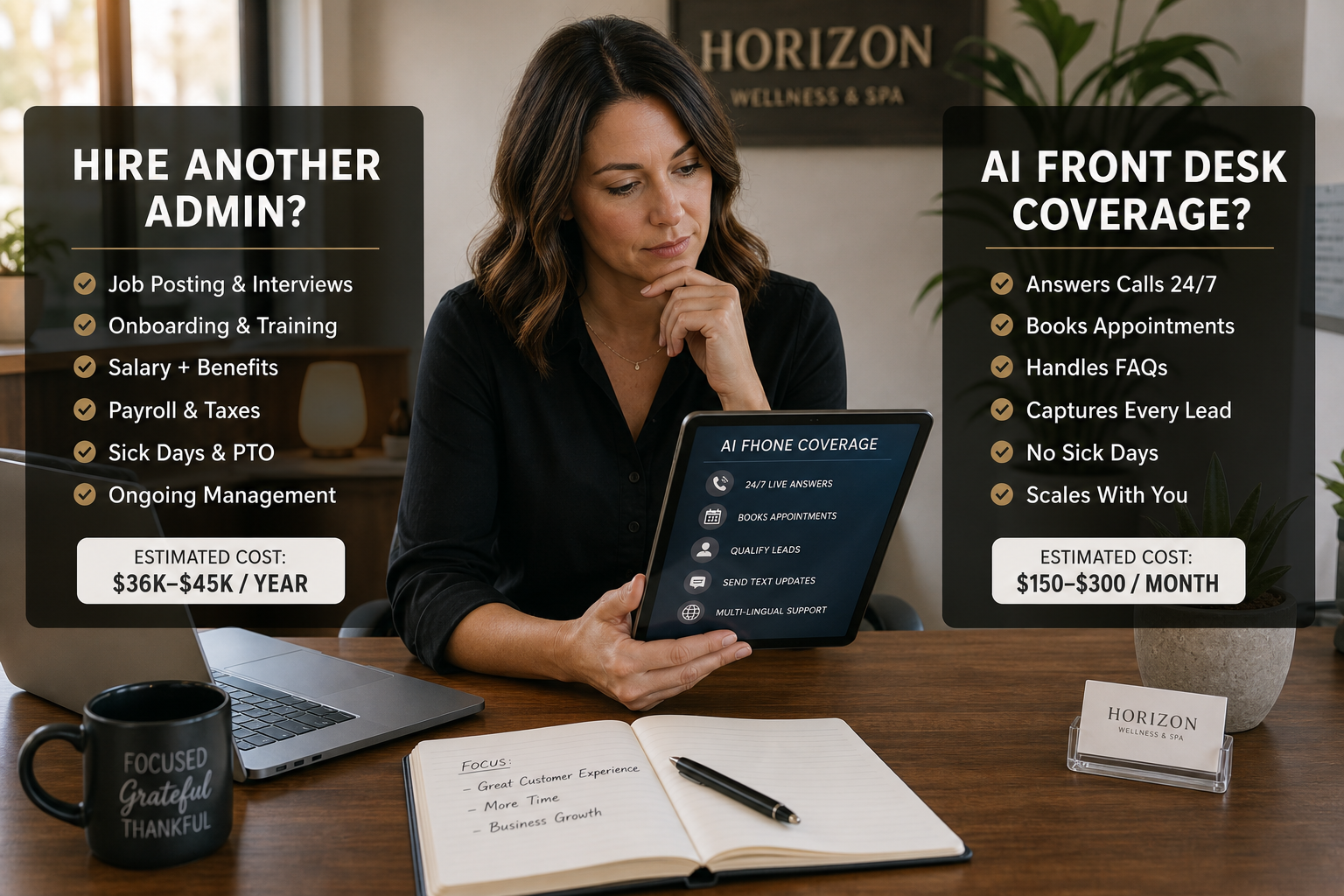
What you are actually buying with another admin
When owners say they need to hire, they usually mean one or more of these outcomes:
- someone picks up the phone consistently
- intake notes are complete
- in-person visitors get attention
- after-hours calls stop dying in voicemail
- the owner stops being the default receptionist
A new admin can deliver those outcomes—when the hire works out, stays, and is scheduled across your failure windows.
But the hire also brings:
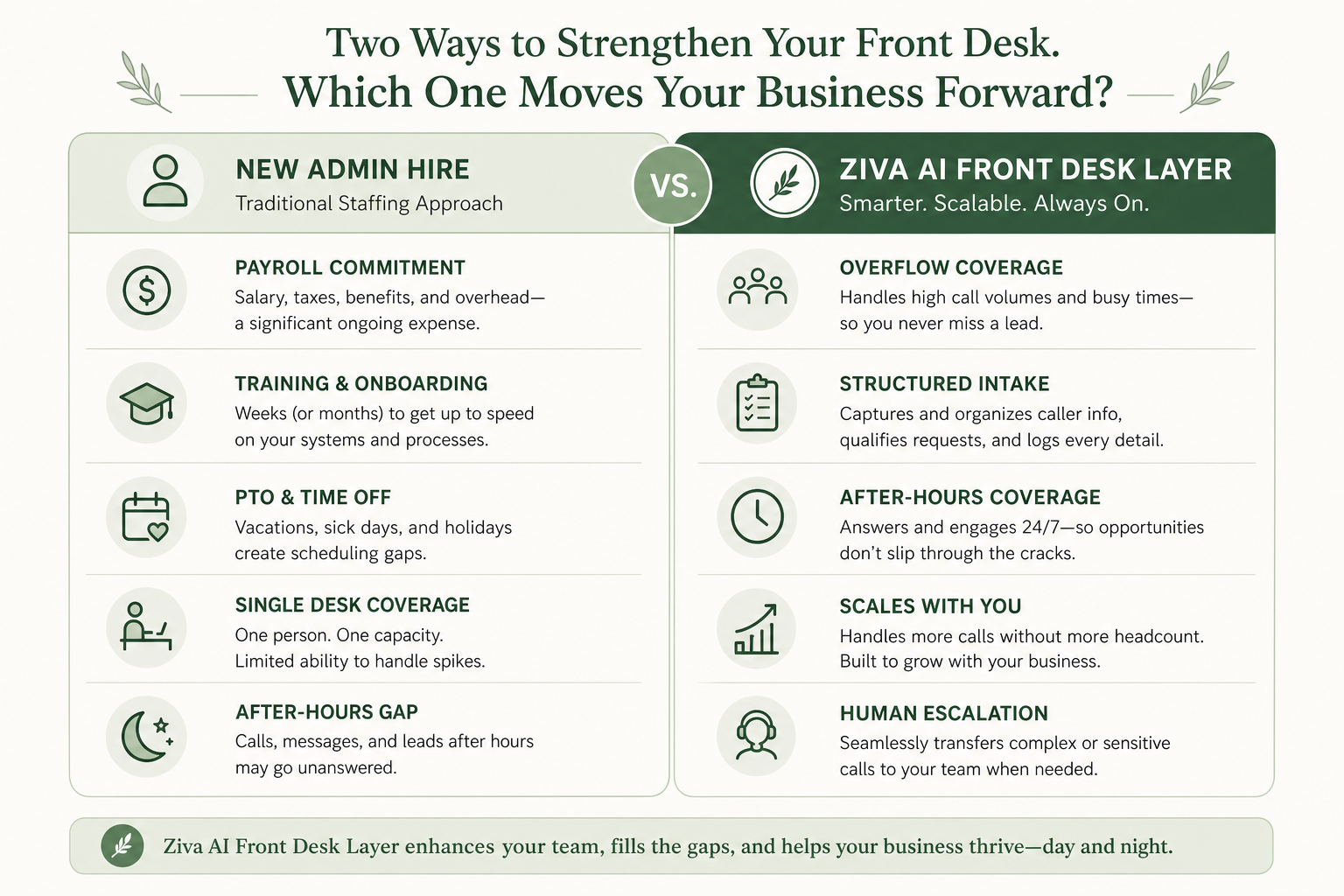
Fully loaded payroll. Salary or hourly pay plus taxes, benefits if offered, workers comp, and recruiting time.
Ramp time. Even experienced admins need weeks to learn your services, tone, escalation rules, software, and seasonal patterns.
Single-desk physics. One person handles one live call and one in-person conversation at a time. Hiring one admin does not automatically fix simultaneous rings or lunch-hour gaps.
Schedule boundaries. Unless you add shifts, "we hired someone" often still means no coverage evenings, weekends, and holidays.
Turnover risk. Front desk and admin roles turn over. Every departure resets training and consistency.
Hiring solves people problems. It does not automatically solve architecture problems—what happens when two channels demand the same person at once.
What an AI front desk layer actually does
Ziva (AI Front Desk), the voice layer behind ZFire Front Desk, is built for bounded first-line coverage:
- answer live on overflow, lunch, and after-hours windows you define
- run structured lead qualification intake
- handle FAQs within guardrails
- route toward booking, callback, or human escalation
- support Missed-Call Text Back when live pickup fails
It does not replace judgment calls, sensitive conversations, or relationship selling that requires a trusted human. It reduces how often those humans get pulled into repetitive intake.
For scope and limits, read what an AI front desk actually does and does not do.
Side-by-side: the same busy week, two strategies
Imagine a plumbing company with one office manager, peak summer volume, and calls stacking between 11 AM and 2 PM.
Strategy A: Hire another admin
- Payroll increases immediately.
- New hire spends the first month learning job types, service area, and who to interrupt for approvals.
- Both admins still collide with in-person walk-ins and field callbacks.
- After-hours calls still hit voicemail unless you pay for extended coverage or on-call rotation.
- When one admin is sick, you are back to a single desk—often without a backup plan.
Strategy B: Add Ziva as a coverage layer
- Live calls get answered in overflow windows while the desk helps in-person customers.
- Intake fields stay consistent because the first line runs a structured script.
- After-hours callers get a professional response instead of a generic beep.
- Humans handle exceptions; automation handles repetition.
- Monthly service adjusts workflows seasonally without re-posting a job listing.
Many businesses end up at Strategy C: both—a lean human desk plus AI coverage for gaps. The mistake is assuming hire alone equals phone solved.
When hiring another admin is the right call
Hire when:
- in-person traffic requires a dedicated human presence most of the day
- complex intake needs continuous judgment—not just scripted fields
- your bottleneck is physical desk work, not phone overflow alone
- you have management bandwidth to train, QA, and retain
- revenue supports fully loaded payroll with margin left over
A second admin is often the right move for busy clinics, high-touch showrooms, and offices where the front desk is the product experience.
When an AI front desk layer fits better first
Consider AI coverage first—or alongside a small team—when:
- missed calls cluster in predictable windows (lunch, after 5 PM, storm days)
- owners or senior staff answer "quick calls" and lose billable time
- intake quality varies because staff multitask
- you need after-hours response but not full overnight staffing
- you want consistent inbound call handling before adding headcount
This is common in trades, solo professional offices, and businesses growing faster than they can hire reliably.
The cost conversation owners skip
Owners compare monthly AI service to admin salary and stop there.
A fair comparison includes:
| Factor | Another admin | AI front desk layer |
|---|---|---|
| Upfront cost | Recruiting, onboarding, equipment | Setup and workflow mapping |
| Ongoing cost | Payroll + taxes (+ benefits) | Monthly service |
| Coverage hours | Limited by shifts | Configurable windows incl. after hours |
| Simultaneous calls | One live conversation per person | Designed for overflow |
| Consistency | Varies by hire, mood, day | Script and guardrails |
| Turnover | Resets training | Workflow updates, not re-hiring |
Neither row is "free." The goal is matching spend to the failure mode you actually have.
See pricing for ZFire Front Desk packaging—not as a substitute for your own payroll math, but as one line item in the comparison.
Hybrid models usually win
The businesses that sound most professional on the phone rarely choose all-human or all-automation.
Typical hybrid:
- Human desk for walk-ins, exceptions, billing disputes, and high-trust conversations
- Ziva for overflow, nights, FAQs, and structured intake
- Clear escalation so callers never feel trapped
- Post-call discipline so summaries reach the right person
That mirrors how strong teams already treat email, web chat, and ticketing—channels get rules, not heroics.
For booking and routing expectations, see can an AI front desk book appointments and route calls.
Questions to ask before you post a job listing
- Where do calls fail? Missed rings, messy answers, or slow follow-up imply different fixes.
- Is the problem hours or headcount? After-hours gaps rarely need a full-time hire on day one.
- What must stay human-only? Everything else is a candidate for first-line coverage.
- What does owner time cost? If you are the backup receptionist, include that in the hire-vs-layer math.
- Can we trial coverage before payroll? Hearing live intake for your call types beats debating abstractly.
If answers point to predictable overflow rather than all-day in-person demand, an AI front desk trial is often faster than a 60-day hiring cycle.
How ZFire Front Desk fits
ZFire Front Desk configures Ziva around your call types, lead qualification rules, and escalation paths—then tunes monthly as seasonality changes.
The goal is not to talk you out of hiring. The goal is to stop treating hiring as the only lever when coverage architecture is the real bottleneck.
Learn how it works, explore solutions by industry, or contact us for a walkthrough of your failure windows.
Take the next step
If you are weighing another admin against phone coverage, start with evidence—not urgency.
Visit the homepage and talk to Ziva—walk through your busiest call scenarios in plain language.
If you want help mapping hire-vs-layer tradeoffs for your operation, contact ZFire Media.
Learn more about ZFire Media and how we help service-based businesses stay responsive without adding payroll stress before the problem is defined.