Pest Control Use Case: Urgent Calls, Recurring Service, and an AI Front Desk
This is a practical use case for pest control and extermination companies—residential and light-commercial operators who live on the phone during swarm season and after every "I just saw something move" moment.
It is a composite scenario, not a named company. The goal is to show how an AI front desk can support real field-service workflows without pretending technology inspects a crawlspace, prices a termite job, or makes pesticide-application decisions that belong to licensed technicians.
If you want the broader picture on peak-season phone strain, read why summer call volume breaks small business phone systems. For a parallel field-service workflow, see the landscaping company use case.
The business in this example
Picture a regional pest control company with a handful of route technicians and one or two office staff.
Technicians run recurring quarterly and monthly accounts, one-time treatments, and inspections. The office handles scheduling, billing, and the steady drip of new calls. When staff are on another line or a tech is mid-treatment in an attic, the phone forwards to voicemail.
Then a swarm season hits. Ants in spring, mosquitoes and wasps in summer, rodents pushing indoors in fall—each wave concentrates calls into short, intense windows. A homeowner who just watched a line of ants cross the kitchen counter is not in a patient mood.
That pattern is common. It is also where revenue leaks: missed calls, incomplete voicemail, and stressed homeowners who dial the next company because nobody answered with a clear next step.
What callers usually want
Most inbound calls fall into a few buckets.
Urgent infestation calls. "There are wasps in the wall," "I think we have bed bugs," or "rodents in the garage"—callers who want reassurance and a fast appointment.
New service estimates. Termite inspections, one-time treatments, or a quote for an ongoing plan.
Recurring account questions. Rescheduling a quarterly visit, "skip the exterior this time," billing questions, or confirming which day a tech is coming.
Seasonal spike curiosity. Comparison shoppers reacting to the first mosquito or the first mouse of the season, calling two or three companies.
Logistics and safety questions. Pet and child safety around treatments, prep instructions, or access details—often phrased anxiously.
None of those needs are exotic. What erodes trust is voicemail during a high-stress moment, or a rushed answer from someone who cannot capture the pest type and address cleanly.
Where pest control phones typically break down
In this scenario, the company struggles with a few repeating failure modes.
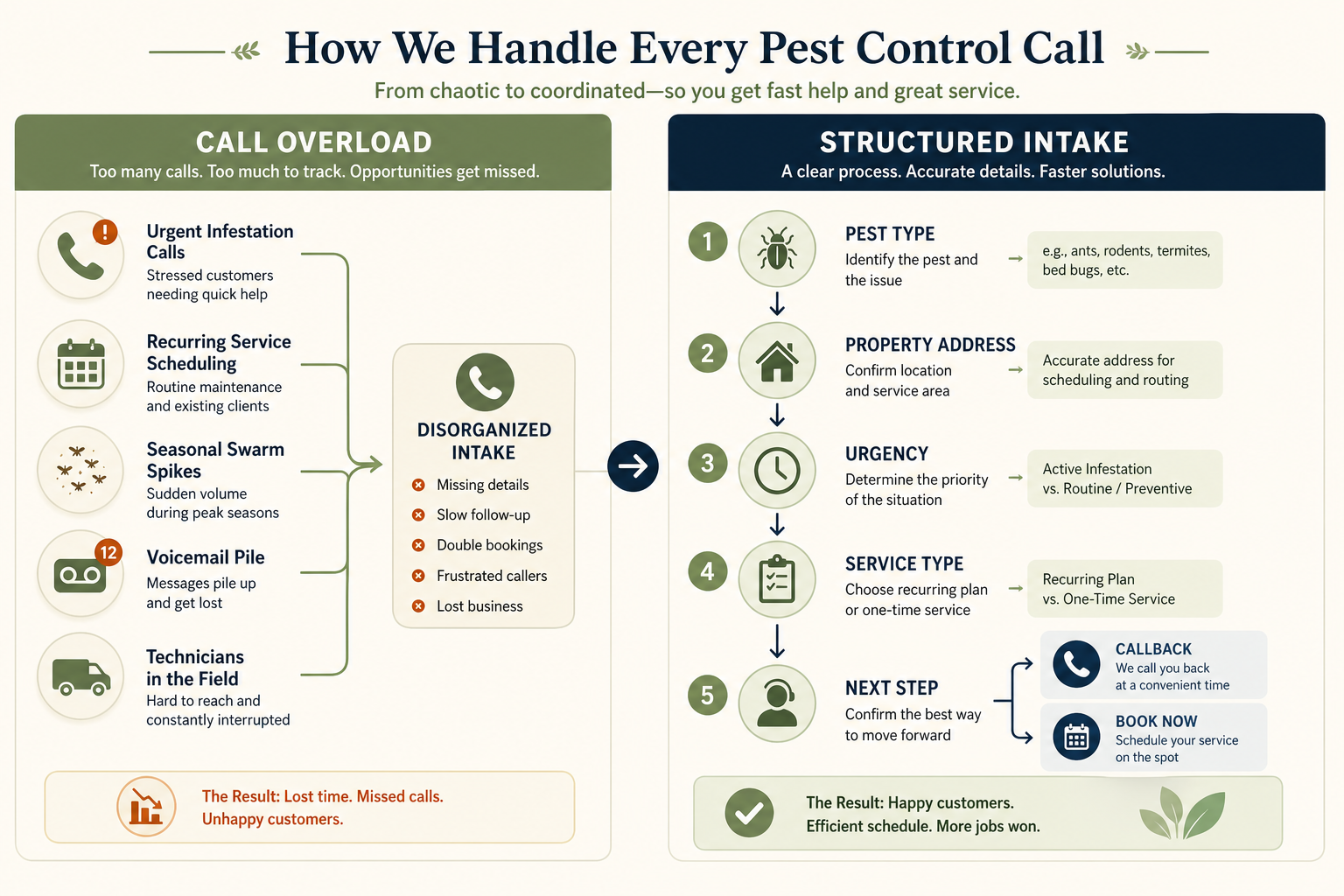
Technicians in the field cannot answer. Treatments, attics, crawlspaces, and drive time mean calls go to voicemail by default.
Seasonal surge overwhelms the office. Swarm-week call volume stacks while the same staff handle billing and existing-customer scheduling.
Voicemail lacks the details techs need. Pest type, property address, whether the problem is active right now, and access notes are often missing—forcing callbacks that start cold.
After-hours and weekend panic. A wasp nest discovered Saturday morning does not wait for Monday. A generic mailbox feels like a closed business.
Urgency is mis-triaged. Not every call is an emergency, but some situations—stinging insects near an allergic person, for example—need faster escalation rules your team defines.
Comparable trade dynamics—without pretending pest control is identical—show up in our HVAC and plumbing use cases: peak load, urgent callers, and the need for structured triage.
What a strong pest control front line should do early
Strong intake for pest control is not about sounding fancy. It is about fast clarity and honest boundaries.
Early conversation can still clarify:
- the caller reached the right company and service area
- what type of pest and problem they are describing, in their own words
- property address and basic access notes
- whether the situation is active and urgent versus routine or preventive
- new customer versus existing recurring account
- what happens next—inspection, treatment window, callback, or escalation
What the front line should not do without human review:
- guarantee pricing or treatment plans sight-unseen
- confirm technician arrival times dispatch has not validated
- identify a pest species as fact or promise eradication outcomes
- give pesticide-safety, health, or application advice regulated in your state
If you are newer to the category, read what an AI front desk actually does and does not do.
How ZFire Front Desk fits a pest control workflow
ZFire Front Desk centers on Ziva as a voice-forward assistant that answers common questions within guardrails, captures structured details, and routes callers using rules your team defines.
In a pest control context, that might include:
- distinguishing urgent infestation versus new estimate versus existing account early
- collecting pest type described by the caller, address, urgency language, and preferred contact window
- capturing recurring-service change requests as structured tickets for office review
- routing defined urgency phrases toward an on-call or priority path your team approves
- supporting after-hours and overflow when techs and the office are occupied
- triggering Missed-Call Text Back when live pickup fails so comparison shoppers get a next step
What it cannot replace is field judgment. Your licensed technicians still inspect, identify pests, choose treatments, price the work, and own pesticide-safety decisions. Ziva reduces the gap between someone called and your team has enough to respond professionally.
For structured first-line patterns, see lead qualification. For inbound coverage philosophy, see inbound call handling.
Escalation and follow-up that match season reality
Some calls carry real urgency: stinging insects near someone with an allergy, a rodent problem in a food-handling setting, or an angry customer whose scheduled service was missed.
The best setups route urgent language to an on-call path your team defines—without the assistant improvising treatment or safety promises.
For routine estimate requests, the win is often speed with structure: enough detail that the office returns a prepared callback or books an inspection instead of playing phone tag.
Post-call discipline matters too. Confirmation texts, calendar blocks for inspections, and follow-up scheduling separate businesses that convert conversations into accounts from those that lose them in the follow-up void. See the 3 things every business should do after a customer call.
How to evaluate fit for your company
Useful questions include:
- what percentage of new business still begins as a phone-first lead
- how often voicemail fails to capture pest type and address basics
- which failure windows repeat every year (spring ant season, summer stinging insects, fall rodents)
- what intake fields your office asks on every callback anyway
- which topics always require a licensed technician or the owner
For workflow mechanics, see how it works. For packaging, see pricing.
Take the next step
If you want to explore whether ZFire Front Desk fits your seasonal call patterns and service intake, contact ZFire Media.
To hear how Ziva handles common pest control caller scenarios, visit the homepage and talk to Ziva.
Learn more about ZFire Media and how we help call-heavy field-service businesses stay responsive through every swarm season.