Landscaping Company Use Case: Seasonal Calls, Estimates, and an AI Front Desk
This is a practical use case for landscaping companies, lawn care operators, and hardscape-light crews that live on the phone every spring—and stay busy through summer and fall.
It is a composite scenario, not a named company. The goal is to show how an AI front desk can support real field-service workflows without pretending technology walks a property, quotes a patio, or dispatches crews from the truck yard.
If you want the broader picture on peak-season phone strain, read why summer call volume breaks small business phone systems. For after-hours gaps, see after-hours call handling for small business.
The business in this example
Picture a twelve-person landscaping operation serving a suburban metro area.
Two maintenance crews run recurring mowing and bed care routes. A project crew handles installs, cleanups, and seasonal work. The owner sells estimates, manages vendors, and still answers overflow when the office line rings through to mobile.
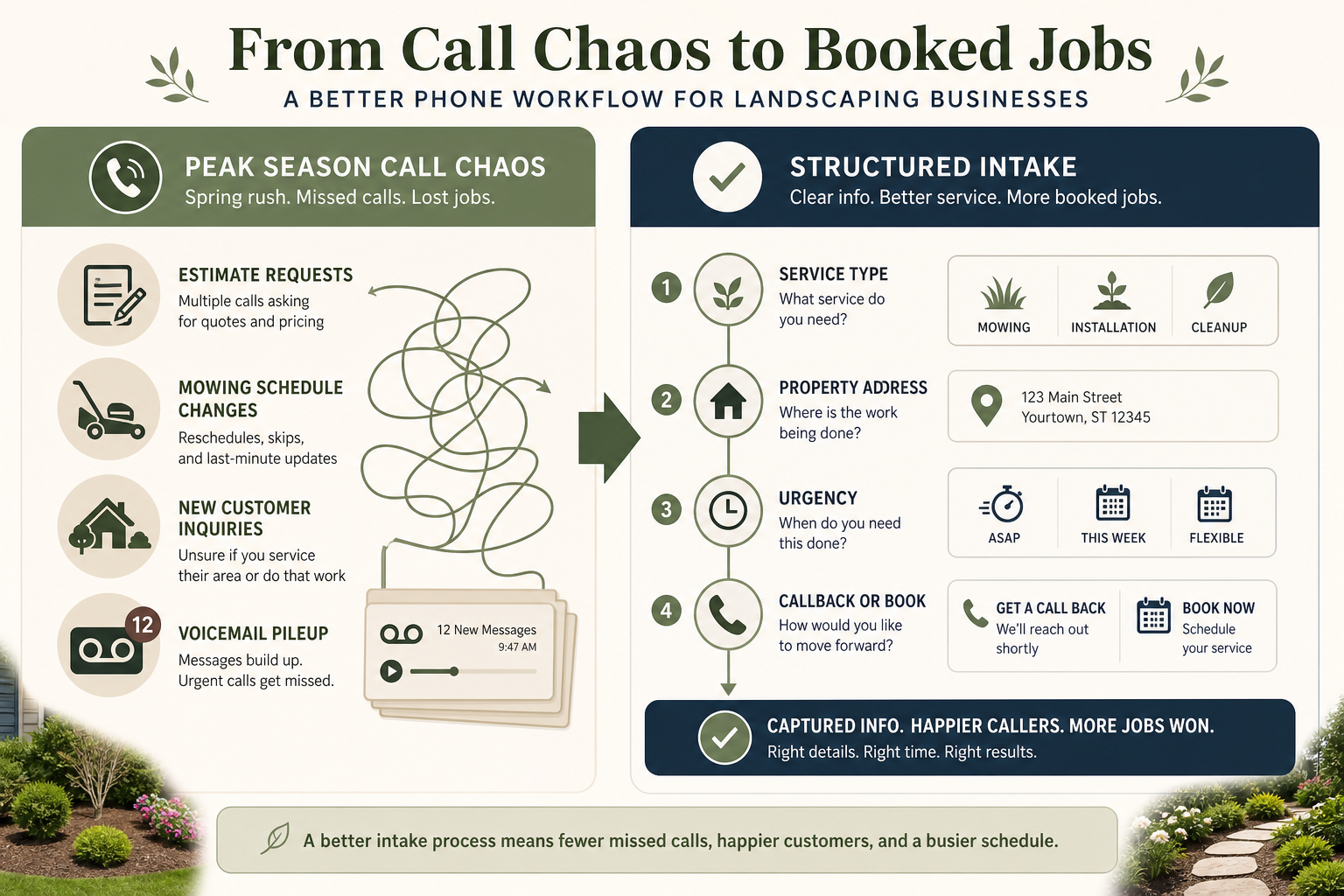
Spring is the pressure cooker: new estimate requests, "can you start this week" calls, cleanup bookings, irrigation turn-ons, and existing customers changing schedules—all while crews are on properties with equipment running and spotty cell coverage.
That pattern is common. It is also where revenue leaks: missed calls, vague voicemail, and homeowners who move to the next company on the list because nobody answered with a clear next step.
What callers usually want
Most inbound calls fall into a few buckets.
New estimate requests. Fresh sod, bed redesign, patio or walkway interest, drainage frustration, or "we just moved in and the yard is a mess."
Recurring service questions. Mowing start dates, frequency changes, billing for seasonal cleanups, or "skip this week because of the party."
Urgent-but-not-emergency issues. Fallen limb cleanup, sprinkler flooding a zone, or a gate left open by a crew—urgent to the homeowner, but not always a same-hour dispatch decision.
Logistics and account updates. Payment questions, access codes, pet instructions, or confirming which day a crew is scheduled.
Comparison shopping. Callers working down three to five names from Google or a neighbor referral. The first organized response often wins the estimate appointment.
None of those needs are exotic. What erodes trust is voicemail, hold without context, or a rushed answer from someone mid-route who cannot capture an address cleanly.
Where landscaping phones typically break down
In this scenario, the operation struggles with a few repeating failure modes.
Crews in the field cannot answer consistently. Mowers, blowers, and drive time mean rings go to voicemail by default.
Spring surge overwhelms one office person. Estimate calls stack while that same person handles billing, vendor callbacks, and customer walk-ins.
Voicemail lacks site detail. Property address, service type, lot access, and photos-or-scope questions are often missing—forcing callbacks that start cold.
After-hours and weekend curiosity. Homeowners research yards on Saturday morning. A generic mailbox feels like a closed business.
Scope promises get improvised. A tired callback that says "we can probably do that Thursday" without calendar discipline creates downstream chaos.
Comparable trade dynamics—without pretending landscaping is identical—show up in our HVAC and plumbing use cases: peak load, urgent language, and the need for structured triage.
What a strong landscaping front line should do early
Strong intake for landscaping is not about sounding fancy. It is about fast clarity and honest boundaries.
Early conversation can still clarify:
- the caller reached the right company and service area
- what type of work they are asking about (maintenance, install, cleanup, irrigation-adjacent, other)
- property address and basic access notes
- timing expectations in plain language your team approves
- what happens next—estimate visit, callback window, or escalation to a project manager
What the front line should not do without human review:
- guarantee pricing, square-foot totals, or material choices sight-unseen
- confirm crew arrival times your dispatch has not validated
- diagnose structural drainage, tree risk, or utility conflicts as fact
- promise chemical or treatment outcomes regulated in your state
If you are newer to the category, read what an AI front desk actually does and does not do.
How ZFire Front Desk fits a landscaping workflow
ZFire Front Desk centers on Ziva as a voice-forward assistant that answers common questions, captures structured details, and routes callers using rules your team defines.
In a landscaping context, that might include:
- distinguishing new estimate versus existing customer versus billing or scheduling early
- collecting address, service type, brief scope language, and preferred contact window
- capturing recurring-service change requests as structured tickets for office review
- supporting after-hours and overflow when crews and the office are occupied
- triggering Missed-Call Text Back when live pickup fails so comparison shoppers get a next step
What it cannot replace is site judgment. Your estimators still walk properties, measure, price materials and labor, and decide what fits your crew capacity. Ziva reduces the gap between someone called and your team has enough to respond professionally.
For structured first-line intake patterns, see lead qualification. For inbound coverage philosophy, see inbound call handling.
Escalation and follow-up that match season reality
Some calls carry real urgency: active irrigation leak flooding a foundation bed, a safety concern from a fallen branch blocking a driveway, or an angry customer whose scheduled service was missed.
The best setups route urgent language to an on-call path your team defines—without the assistant improvising dispatch promises.
For routine estimate requests, the win is often speed with structure: enough detail that a project manager returns a prepared callback or books a site visit instead of playing phone tag.
Post-call discipline matters too. Confirmation texts, calendar blocks for estimates, and follow-up scheduling separate businesses that convert conversations into jobs from those that lose them in the follow-up void. See the 3 things every business should do after a customer call.
How to evaluate fit for your company
Useful questions include:
- what percentage of spring revenue still begins as a phone-first lead
- how often voicemail fails to capture address and scope basics
- which failure windows repeat every year (March–May surge, Monday mornings, after 5 PM)
- what intake fields your estimators ask on every callback anyway
- which topics always require the owner or a project manager
For workflow mechanics, see how it works. For packaging, see pricing.
Take the next step
If you want to explore whether ZFire Front Desk fits your seasonal call patterns and estimate intake, contact ZFire Media.
To hear how Ziva handles common landscaping caller scenarios, visit the homepage and talk to Ziva.
Learn more about ZFire Media and how we help call-heavy field-service businesses stay responsive through peak season.