Law Firm Use Case: New Client Intake, Consultations, and an AI Front Desk
This is a practical use case for small and mid-size law firms—personal injury, family, estate planning, immigration, criminal defense, and general practice offices that still live on the phone.
It is a composite scenario, not a named firm. Nothing here is legal advice, ethics guidance, or a substitute for your jurisdiction's rules of professional conduct.
The goal is to show how an AI front desk can tighten first-line intake and routing while keeping expectations honest: automation supports responsiveness; licensed attorneys own judgment, conflicts, and representation.
If you want the broader revenue picture behind missed rings, read why small businesses lose revenue when calls go unanswered. For professional-office comparison dynamics, see real estate brokerage use case.
The firm in this example
Picture a six-attorney firm with two practice concentrations and a lean front office.
One legal assistant handles intake, calendaring, and billing questions. Attorneys are in court, depositions, client meetings, and document review blocks most days. The main line forwards to mobile when nobody is at the desk—and after hours, callers often hit voicemail.
That pattern is common in boutique firms. It is also where opportunities leak: potential clients who needed a competent first response, existing clients who could not reach someone about a deadline, and referral partners who expect professional phone handling.
For after-hours behavior, see after-hours call handling for small business.
What callers usually want
Most inbound calls cluster into a few buckets.
New potential clients. "I need to speak with a lawyer about…" followed by urgency, fear, or comparison shopping across two or three firms.
Existing clients. Status questions, document requests, hearing dates, billing, or "I need to talk to my attorney today."
Referral and partner calls. Other attorneys, medical providers, insurers, or court staff needing a clear routing path—not a vague "leave a message."
General office logistics. Office location, hours, retainer process language your firm approves, and how consultations are scheduled.
Wrong-number or out-of-scope inquiries. Callers who need a different practice area or jurisdiction—where polite, fast redirection protects everyone.
None of those needs are unreasonable. What erodes trust is voicemail during high-intent moments, repeated transfers without context, or confident answers about outcomes a lawyer has not reviewed.
Where law firm phones typically break down
In this scenario, the firm struggles with repeatable failure modes.
Attorneys unavailable during court and client blocks. The phone rings to voicemail while the caller is still motivated.
Intake happens while distracted. A legal assistant helping a walk-in client half-captures a new lead's details.
Urgency is mis-triaged. Not every caller is an emergency—but some language patterns need fast escalation rules your team defines.
Conflict and screening steps get skipped under pressure. Rushing intake creates downstream ethics and operations risk.
After-hours potential clients comparison-shop. The firm that sounds organized at 8 PM often gets the consultation request first.
Callback starts cold. "Someone called about a case" without practice area, timeline, or opposing-party basics wastes attorney time.
Comparable professional-office patterns—with different licensing—appear in our real estate brokerage and dental practice use cases: structured intake plus human ownership of regulated advice.
What a respectful law firm front line should do early
Strong legal intake avoids turning the phone into informal representation.
Early conversation can still clarify:
- the caller reached the intended firm
- whether they are a new inquiry, existing client, or other (referral, vendor, court)
- practice area interest described in the caller's words—not labeled as a legal conclusion
- contact information and preferred callback window
- general process language your firm approves—for example how consultations are scheduled and what documents may be requested later
- clear next steps that do not promise outcomes, timelines, fees beyond published ranges, or strategy
What the front line should not do without attorney review:
- provide legal advice or apply law to specific facts
- assess case value, likelihood of success, or statute-of-limitations conclusions
- speak about opposing parties in ways that create conflict or prejudice
- confirm attorney-client relationships before your conflicts process runs
- discuss fee arrangements beyond approved scripts
If you are newer to the category, read what an AI front desk actually does and does not do.
How ZFire Front Desk fits a law firm workflow
ZFire Front Desk centers on Ziva as a voice-forward assistant that answers common questions within guardrails, captures structured details, and routes callers using rules your firm defines with ethics and intake leadership.
In a law firm context, that might include:
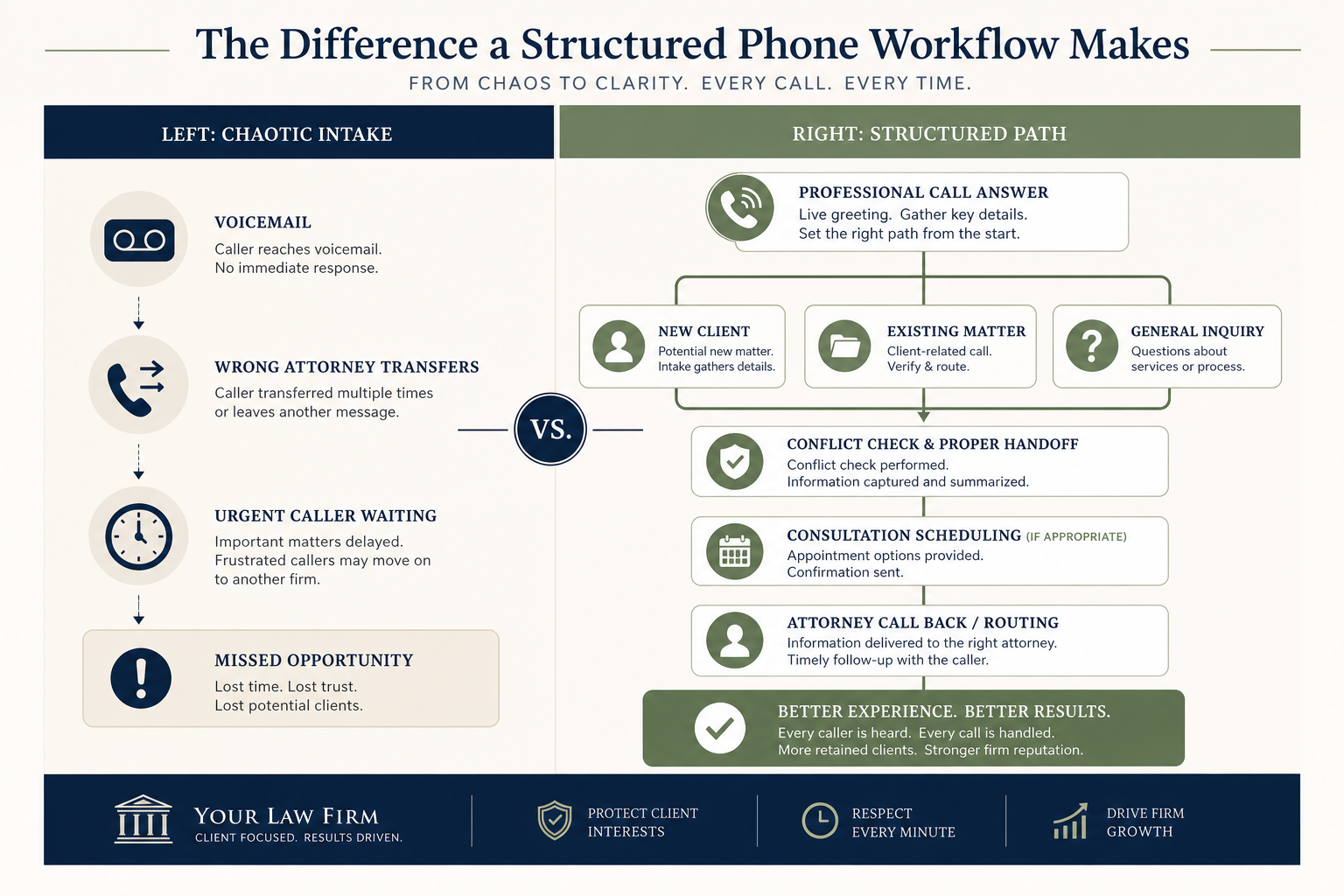
- distinguishing new client inquiry versus existing matter versus general office early
- collecting name, callback number, practice area interest, and urgency language as described by the caller
- routing high-priority language to an on-call or duty attorney path your firm approves
- supporting after-hours and overflow when staff are in court or with clients
- triggering Missed-Call Text Back when live pickup fails so comparison shoppers get a next step
- handing structured summaries to intake staff for conflicts checks and consultation scheduling
What it cannot replace is legal judgment. Your attorneys still evaluate facts, run conflicts analysis, set strategy, and enter representation. Ziva reduces the gap between someone called and your team has enough to respond professionally.
For structured first-line patterns, see lead qualification. For inbound coverage philosophy, see inbound call handling.
Escalation and follow-up that match legal urgency
Some calls carry real time pressure: custody hearing tomorrow, arrest-related questions, deadline language, or an existing client reporting a new development.
The best setups route defined urgency phrases to a human path your firm approves—without the assistant improvising legal guidance.
For routine new inquiries, the win is often speed with structure: enough detail that intake staff or an attorney returns a prepared callback instead of replaying phone tag.
Post-call discipline matters: confirmation of consultation times, calendar blocks, and follow-up tasks. See the 3 things every business should do after a customer call.
How to evaluate fit for your firm
Useful questions include:
- what share of new matters still begin as phone-first contacts
- how often voicemail delays first contact past your internal standard
- which intake fields your team asks on every new client call anyway
- which topics always require an attorney or intake lead immediately
- what after-hours volume looks like—and whether it is mostly new leads or existing clients
For workflow mechanics, see how it works. For packaging, see pricing.
Take the next step
If you want to explore whether ZFire Front Desk fits your firm's intake language and routing rules, contact ZFire Media.
To hear how Ziva handles common law firm caller scenarios within boundaries, visit the homepage and talk to Ziva.
Learn more about ZFire Media and how we help professional offices stay responsive without blurring legal advice lines.