Property Management Use Case: Tenant Calls, Leasing Leads, and an AI Front Desk
Tenant calls do not follow office hours.
A resident notices water under a sink at 8:15 PM. A prospective renter calls during lunch after seeing a listing. A vendor needs access instructions while the property manager is already speaking with an owner.
None of those calls necessarily requires the same person or the same response. But when they all land on one office line, the default outcome is often voicemail, an incomplete message, or an interruption that pushes another task behind.
This is a practical use case for residential property managers and small management companies. It is a composite scenario, not a named company. The goal is to show how a basic AI front desk can improve first-line intake without pretending it can determine lease eligibility, diagnose maintenance problems, authorize repairs, or replace property-management judgment.
For the broader operational cost of constant phone disruption, read why front desk interruptions cost more than most owners realize. For nights and weekends, see after-hours call handling for small business.
The management company in this example
Picture a local company managing several hundred residential units across scattered apartment buildings and single-family rentals.
The office has two property managers, a leasing coordinator, and an administrator. Maintenance is handled by a mix of in-house technicians and outside vendors. During business hours, the same people who answer tenant calls are also reviewing applications, coordinating turns, speaking with owners, handling notices, and following up on work.
After hours, the main number forwards to voicemail or an on-call phone. Routine questions and genuine maintenance concerns arrive through the same channel, forcing someone to listen, interpret, and decide what deserves attention.
The problem is not simply call volume. It is call variety. A prospective renter asking about the pet policy, a resident reporting no heat, and a vendor requesting a lockbox code should not enter the same undifferentiated message pile.

What callers usually need
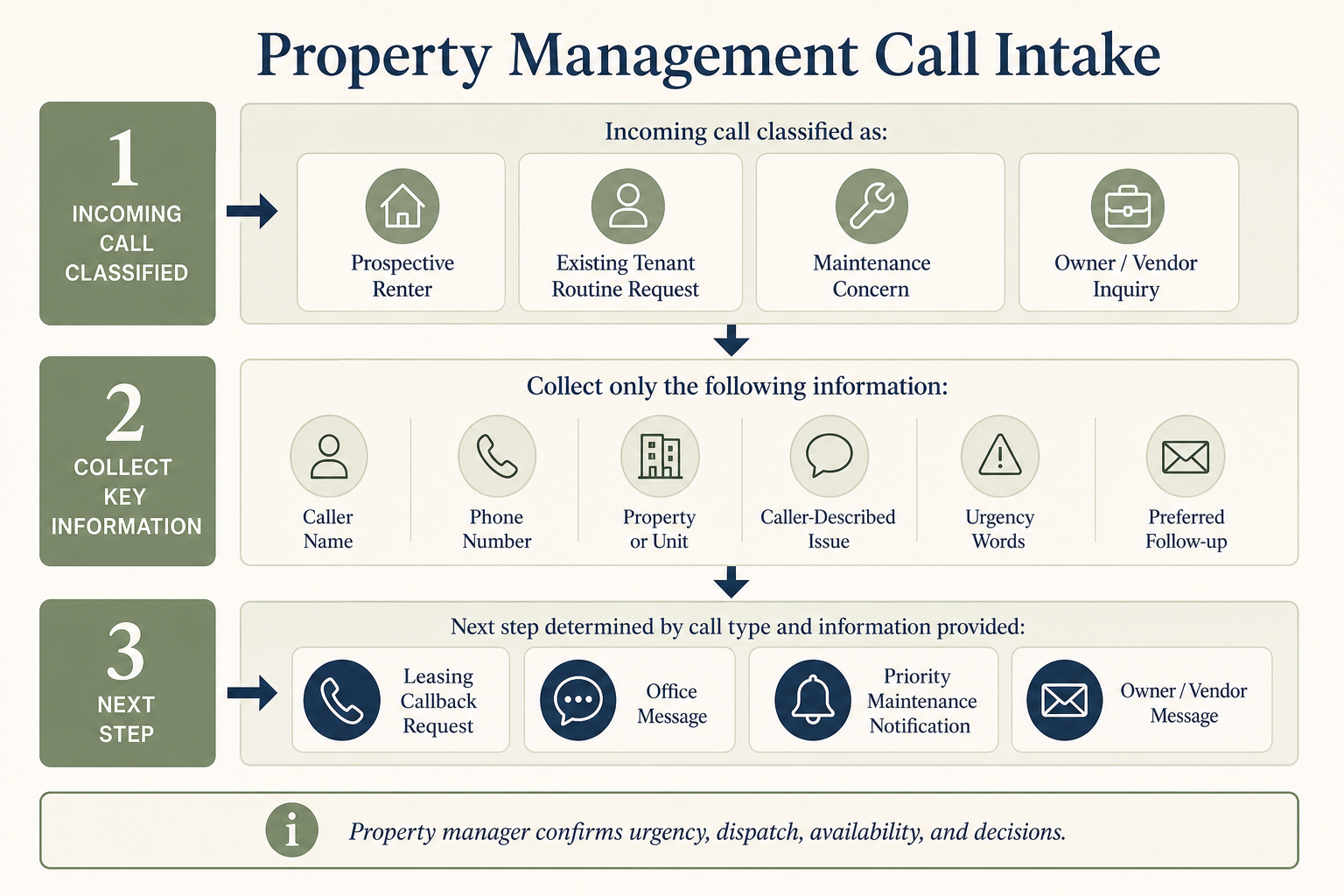
Most property-management calls fall into a few recognizable groups.
Prospective renters. Listing questions, showing requests, application-process questions, general pet or parking policies, and requests for a leasing callback.
Existing tenants with routine requests. Account questions, inspection scheduling, office hours, document requests, or a non-urgent maintenance issue.
Maintenance concerns. Water, heating or cooling, electrical symptoms, access problems, appliance failures, and other conditions described by the tenant.
Owners and vendors. Property updates, invoice questions, access coordination, scheduling, and requests for a particular team member.
General or misdirected calls. Applicants checking status, sales vendors, neighboring residents, or callers who reached the wrong management company.
What callers want first is not always a complete resolution. They want confirmation that they reached the right place, that the important details were captured, and that the next step matches the situation.
Where the phone workflow breaks
In this scenario, several failure modes repeat.
Leasing calls arrive while staff are showing units. A prospect leaves no voicemail and moves to the next available property.
Maintenance messages lack usable detail. “Something is leaking” does not tell the manager which property, unit, fixture, or whether water is actively spreading.
Routine and urgent calls share one inbox. A general policy question sits beside a time-sensitive maintenance concern with no structure separating them.
Tenants repeat themselves. The first message is incomplete, so the property manager starts the callback by collecting everything again.
The on-call person becomes the universal front desk. Nights and weekends get consumed by calls that could have been captured for the next business day.
Staff improvise housing answers. A rushed response about availability, screening, accommodations, or applicant status can create confusion and fair-housing risk.
These are architecture problems, not evidence that staff do not care. One line is being asked to serve leasing, resident service, maintenance intake, owner communication, and vendor coordination at the same time.
What a responsible first line should capture
A basic property-management front desk should stay focused on facts the caller provides and the next step the company has approved.
Depending on the call type, intake may include:
- caller name and reliable callback number
- property or community name
- unit number when applicable
- prospective renter, existing tenant, owner, vendor, or other
- the issue or request in the caller's own words
- urgency language without diagnosing the problem
- access notes the caller volunteers
- preferred follow-up time
The assistant can then classify the message into a defined path: leasing callback request, routine office follow-up, priority maintenance notification, or owner/vendor message.
That is different from deciding the outcome.
The property manager still confirms urgency, dispatches vendors, approves expenses, checks availability, interprets leases, and makes applicant or resident decisions.
Boundaries that matter in property management
Property-management calls can touch safety, housing law, privacy, and money. The safest system is explicit about what it does not decide.
An AI front desk should not:
- determine whether a condition legally makes a unit uninhabitable
- tell a tenant to perform electrical, gas, structural, or plumbing repairs
- promise a technician arrival time that dispatch has not confirmed
- approve reimbursements, rent credits, lease changes, or vendor work
- determine applicant eligibility or discuss protected-class preferences
- improvise accommodation, service-animal, screening, or eviction guidance
- disclose tenant, owner, access, or account information without authorization
Emergency and safety language should follow a short script approved by the management company and its counsel. The assistant can recognize defined terms and escalate or provide the approved emergency instruction. It should not diagnose the event.
For the general principle, read what an AI front desk actually does and does not do.
How ZFire Front Desk fits the workflow
ZFire Front Desk, powered by Ziva, can provide a structured first response during overflow and after-hours windows.
For a property-management company, a basic setup might:
- identify the caller category early
- answer a bounded set of office and leasing FAQs
- capture consistent leasing-interest details
- collect tenant-reported maintenance information
- apply approved escalation rules to defined urgency language
- transfer priority calls to one on-call route when configured
- fall back to a structured message when nobody accepts the transfer
- send the appropriate team an actionable call summary
It should start narrow. A first version does not need to create work orders, update a property-management system, schedule vendors, or expose live unit availability.
Those integrations can be evaluated later, after the intake and handoff workflow works reliably.
For how structured first-line information gathering works, see lead qualification. For the broader coverage model, see inbound call handling.
A practical after-hours example
Consider two calls arriving after the office closes.
The first caller is a prospective renter asking whether a property allows pets and how to request a tour. Ziva can answer only the approved general policy, collect contact details and property interest, and create a leasing callback request.
The second caller is an existing tenant describing water spreading from beneath a sink. Ziva captures the property, unit, callback number, what the tenant sees, and urgency language. Based on the management company's rules, the call can be transferred to the on-call path or flagged for priority follow-up.
In neither case does the assistant promise availability, approve an application, diagnose the leak, or dispatch a vendor.
The value is simpler: the right information reaches the right human with less delay and less repetition.
What to measure during a pilot
Before making broad claims, a property-management company can evaluate a short pilot using operational measures:
- percentage of calls that produced a usable message
- percentage of required intake fields captured
- leasing inquiries delivered to the correct person
- priority maintenance calls that followed the approved escalation path
- transfer attempts that connected or used the correct fallback
- unsupported promises or disclosures
- staff assessment of whether summaries reduced callback time
Do not optimize only for calls “resolved without a human.” Property management contains too many decisions that should remain human. Correct intake and safe escalation are better starter goals.
How to evaluate fit
Useful questions include:
- Which calls repeatedly interrupt leasing or property-management work?
- What information is missing from maintenance voicemail today?
- Which situations require an immediate on-call notification?
- Which questions have approved, stable answers?
- Which topics must always go to a licensed manager, attorney, or trained employee?
- How are recordings, transcripts, and tenant information retained?
For implementation steps, see how ZFire Front Desk works. For current packaging, see pricing.
Take the next step
If your property-management office needs more consistent overflow or after-hours intake, contact ZFire Media to discuss one focused call flow.
You can also visit the homepage and talk to Ziva to hear how a structured first response feels in practice.
Learn more about ZFire Media and our approach to practical, bounded AI call coverage for service businesses.