Med Spa Use Case: Consultations, Bookings, and an AI Front Desk
This is a practical use case for medical spas and aesthetic practices that run on the phone.
It is a composite scenario, not a named business. The goal is to show how an AI front desk can support client-facing call workflows without replacing medical judgment, informed consent conversations, or the way your practice handles clinical questions.
If you want the broader picture on missed calls, read why small businesses lose revenue when calls go unanswered.
The practice in this example
Picture a busy med spa offering a mix of consult-driven services: skin treatments, injectable appointments booked only after evaluation, and membership-style maintenance visits.
The front desk is doing three jobs at once: greeting arrivals, managing checkout, and answering a steady stream of "quick questions" that are rarely quick.
Callers often want pricing ranges, availability, whether they are a candidate, and reassurance that they are booking with a credible team.
That combination is normal. It is also where revenue leaks happen: slow response, vague voicemail, and shoppers who move on to the next practice that sounds organized.
For after-hours curiosity and urgency patterns, see after-hours call handling for small business.
What callers usually want
Most calls fall into a few buckets.
Some callers need scheduling: consultations, follow-up visits, or treatment series planning.
Some callers want education at a high level: what a service is for, what preparation might look like, and what the general visit flow is.
Some callers ask candidacy questions that sound simple but are not simple at all: allergies, pregnancy, recent procedures, medications, and contraindications that belong in a clinical review.
Some callers are comparison shopping and will choose whoever responds with clarity and professionalism.
Where the phone breaks for med spas
In this scenario, the practice struggles with predictable failure modes.
Calls stack during peak arrival windows.
Voicemail delays consult bookings, especially for high-intent new clients.
Front desk multitasking creates uneven experiences: great in person, inconsistent on the phone.
After hours, the line still represents your brand. A generic mailbox can feel like a luxury business operating like a low-budget call center.
For a parallel healthcare-adjacent write-up with similar boundaries, see our dental practice use case.
What a strong front line sounds like in a med spa context
Clients want confidence: they reached the right place, their time is respected, and the next step is clear.
That is not the same as promising outcomes or answering candidacy on the fly.
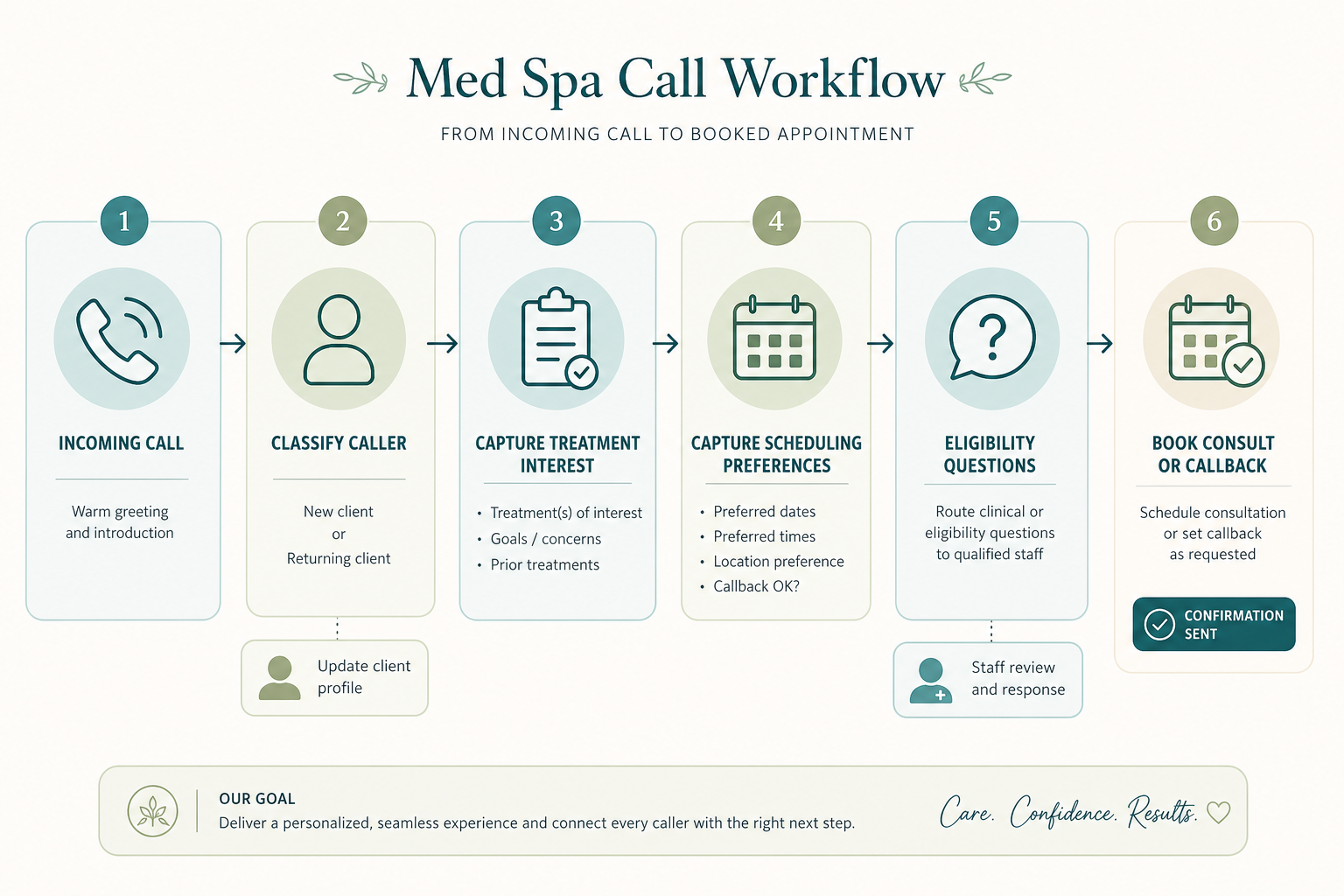
Good intake is structured: what they are interested in, timing preferences, whether they are new to the practice, and whether they have urgency language that should route to a clinician or triage path based on your standards.
If you are newer to the category itself, read what an AI front desk actually does and does not do.
How ZFire Front Desk fits a med spa workflow
ZFire Front Desk centers on Ziva as a voice-forward assistant that can answer common questions, capture structured details, and route callers based on rules you define.
In a med spa context, that might include:
- helping callers understand how to start (consultation first vs direct booking), depending on your policy
- capturing name, callback number, service interest, and timing preferences
- routing clinical-sounding concerns to staff based on trigger language you choose
- supporting after-hours coverage so fewer inquiries die on voicemail
The exact setup depends on your services, your compliance posture, and how you want clinical questions handled.
What it should not pretend to do
An AI front desk should not act like a licensed provider.
It should not diagnose conditions, recommend specific treatments for an individual, or clear someone as a candidate without a proper evaluation.
It should not provide medical advice, medication guidance, or detailed post-care instructions that should come from your clinical team.
Sensitive clinical questions belong with trained staff or providers, following your practice protocols.
Clear boundaries increase trust, especially in aesthetics where clients are already cautious.
Escalation that matches real client risk
The best implementations make escalation obvious and repeatable.
If a caller describes severe swelling, infection concern, vascular symptoms, or other red-flag language, your policy might require immediate staff involvement or direction to emergency care when appropriate.
For routine scheduling and education questions, the win is often cleaner capture and fewer dropped threads between "someone called" and "the practice can act."
How to evaluate fit for your practice
Useful questions include:
- what percentage of revenue starts with a phone inquiry
- how often slow response loses consult bookings
- what facts your coordinators need on every new client call
- which questions must always reach a human quickly
For workflow detail, read how it works. For packaging, see pricing.
Take the next step
If you want to explore whether ZFire Front Desk could match your call patterns and policies, contact ZFire Media.
If you want to hear how Ziva sounds first, visit the homepage and talk to Ziva.
Learn more about ZFire Media and how we work with call-heavy small businesses.